LSD: The Complete Guide to Effects, Dosage, Therapy & Safety
Last Updated: Thursday 9th April 2026
What is LSD? (History)
LSD (Lysergic acid diethylamide) is one of the most potent and well-studied psychedelic compounds known to science. Discovered in 1938 by Swiss chemist Albert Hofmann at Sandoz Laboratories, it is remained relatively obscure until Hofmann accidentally absorbed a small amount through his skin on April 19, 1943 — a date now celebrated as “Bicycle Day” after his famous bicycle ride home while under its effects.
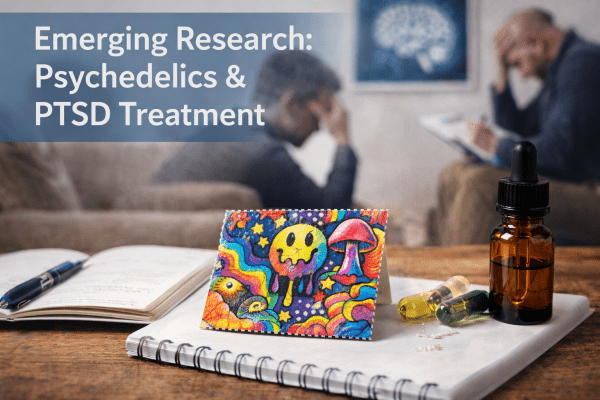
Key Historical Milestones:
| Year | Event |
|---|---|
| 1938 | First synthesized by Albert Hofmann |
| 1943 | First intentional ingestion (250 µg) |
| 1950s–1960s | Used experimentally in psychiatry (over 40,000 patients) |
| 1966 | Banned in the United States |
| 1971 | Classified as Schedule I under UN Convention |
| 2000s–present | Resurgence of clinical research for PTSD, depression, and anxiety |
LSD was initially marketed as “Delysid“ for psychiatric research, with Sandoz suggesting psychiatrists take it themselves to “understand their patients’ subjective experiences.” The 1960s counterculture, led by figures like Timothy Leary and Ken Kesey, pushed it into public consciousness — and ultimately into prohibition.
📖 Scientific fact: LSD is active at doses as low as 20 micrograms — approximately the weight of a few grains of salt.
LSD Effects
LSD primarily affects the serotonin 2A receptor (5-HT2A) , leading to altered brain connectivity and subjective effects that vary by dose, set (mindset), and setting (environment).
Common LSD Effects:
| Category | Effects |
|---|---|
| Visual | Geometric patterns, enhanced colors, tracers, closed-eye visuals |
| Auditory | Music enhancement, synesthesia (hearing colors/seeing sounds) |
| Emotional | Euphoria, awe, fear (anxiety), emotional release |
| Cognitive | Altered sense of time, ego dissolution, creative thinking |
| Physical | Dilated pupils, increased heart rate, mild nausea, yawning |
Therapeutic vs. Recreational Effects:
In clinical settings, it produces “mystical-type experiences” — characterized by unity, transcendence of time/space, and ineffability — which correlate with long-term positive outcomes in treating PTSD and depression.
⚠️ Warning: LSD can also induce “bad trips” — intense fear, paranoia, or psychotic-like symptoms — especially at high doses or without proper preparation.
LSD Dosage
LSD dosage is measured in micrograms (µg) . One microgram = one-millionth of a gram.
Standard Dosage Ranges:
| Dose (µg) | Experience Level | Effects |
|---|---|---|
| 10–20 µg | Microdose | Sub-perceptual, mood boost, no visuals |
| 25–50 µg | Low | Mild visual changes, enhanced thinking |
| 50–100 µg | Moderate | Full psychedelic experience, moderate visuals |
| 100–200 µg | High | Strong visuals, ego dissolution possible |
| 200–400 µg | Very High | Intense experience, loss of reality anchor |
| 400+ µg | Heroic | High risk of psychosis, not recommended |
📌 Important: Street LSD varies widely in purity. Most “tabs” contain 50–150 µg, but testing is the only way to know.
Factors Affecting Dosage Response:
-
Body weight (minimal effect — Also acts on brain receptors)
-
Metabolism (individual variation)
-
Tolerance (builds rapidly after one dose; returns to baseline after 10–14 days)
-
Medications (SSRIs and antipsychotics reduce or block effects)
How Long Does an LSD Trip Last?
LSD has a relatively long duration compared to other psychedelics like DMT or psilocybin.
Typical LSD Timeline:
| Time | Phase | Description |
|---|---|---|
| 0–30 min | Onset | First subtle effects: anxiety, nausea, color brightening |
| 30–90 min | Come-up | Increasing intensity, visual distortions begin |
| 2–4 hours | Peak | Maximum effects; ego dissolution possible |
| 4–6 hours | Plateau | Sustained intensity, gradual decline |
| 6–8 hours | Come-down | Effects fading, residual stimulation |
| 8–12 hours | Baseline | Near-normal cognition, afterglow possible |
⏱️ Total duration: 8–12 hours, with after-effects (insomnia, mild visual noise) lasting up to 24 hours.
What Impacts Duration?
-
Dose: Higher doses prolong the peak and total duration
-
Route: Oral ingestion is standard; effects last 8–12 hours
-
Individual metabolism: Some return to baseline faster
-
Medications: Benzodiazepines shorten or abort trips
LSD Safety
LSD is considered physically safe with an extremely high therapeutic index. The lethal dose is estimated above 20,000 µg — over 100 times a typical high dose. No deaths from LSD overdose alone have been verified in medical literature.
Primary Risks:
| Risk | Description |
|---|---|
| Bad trip (psychological distress) | Most common adverse effect; preventable with preparation |
| HPPD (Hallucinogen Persisting Perception Disorder) | Rare; visual disturbances lasting weeks/months |
| Psychosis trigger | Can unmask latent schizophrenia in predisposed individuals |
| Accidents | Impaired judgment leading to falls, drowning, or dangerous behavior |
Harm Reduction Guidelines:
✅ Do:
-
Test your substance with reagent kits (Ehrlich, Hofmann)
-
Use in a safe, familiar environment
-
Have a sober, trusted sitter
-
Start with a low dose (50–100 µg)
-
Stay hydrated but not overhydrated
❌ Don’t:
-
Combine with alcohol, stimulants, or MAOIs
-
Drive or operate machinery
-
Use if you have personal/family history of psychosis
-
Take if you’re in a negative emotional state
-
Redose after the first hour (tolerance blocks effects)
🚨 Medical note: Benzodiazepines (e.g., Xanax, Valium) and antipsychotics (e.g., Seroquel) can effectively abort a bad trip.
Microdosing LSD
Microdosing refers to taking sub-perceptual doses of LSD — typically 10–20 µg — on a regular schedule without experiencing full psychedelic effects.
Common Microdosing Protocols:
| Protocol | Schedule |
|---|---|
| Fadiman | Dose day, transition day, no-dose day (repeat) |
| Stamets Stack | 4 days on, 3 days off (usually with psilocybin) |
| Intuitive | As needed, without fixed schedule |
Reported Benefits (Anecdotal & Preliminary Research):
-
Enhanced mood and creativity
-
Reduced anxiety and depression symptoms
-
Improved focus and problem-solving
-
Increased emotional openness
Known Risks & Limitations:
-
Placebo effect: Many benefits may come from expectation, not pharmacology
-
Cardiovascular concerns: Theoretical risk with long-term use (5-HT2B receptor)
-
Unknown long-term effects: No longitudinal studies exist
🔬 Research note: A 2021 study in Biological Psychiatry found microdosing LSD (13 µg) produced mild subjective effects — not truly “sub-perceptual” — suggesting the term may be misleading.
LSD Therapy
LSD-assisted therapy (LAT) is the controlled administration of LSD within a psychotherapeutic framework — typically one to three high-dose sessions supported by preparation and integration.
How LSD Therapy Works:
| Phase | Description |
|---|---|
| Preparation (2–4 sessions) | Build rapport, set intentions, teach coping skills |
| Medicine session (6–10 hours) | Administer in comfortable room; therapists provide non-directive support |
| Integration (2–4 sessions) |
Process experience, reinforce insights, apply to daily life |
Conditions Being Studied:
| Condition | Evidence Level |
|---|---|
| PTSD (Post-Traumatic Stress Disorder) | Promising Phase 2 results |
| Treatment-resistant depression | Strong preliminary evidence |
| End-of-life anxiety | Multiple positive trials |
| Alcohol use disorder | Historic studies showed benefit; modern replication ongoing |
| Obsessive-compulsive disorder (OCD) | Small studies suggest potential |
Key Clinical Findings:
-
A 2022 systematic review found LSD significantly reduced anxiety and depression in patients with life-threatening illnesses
-
Effects after one to two sessions can last 6–12 months or longer
-
Therapeutic success depends heavily on psychological support, not just the drug
📍 Legal status in Germany: LSD is Schedule I under BtMG. LSD therapy is only available in approved clinical trials — not in private practice.
LSD vs. Magic Mushrooms
LSD and psilocybin (magic mushrooms) are often compared. While similar, they have meaningful differences.
Comparison Table:
| Feature | LSD | Magic Mushrooms (Psilocybin) |
|---|---|---|
| Chemical class | Lysergamide | Tryptamine |
| Duration | 8–12 hours | 4–6 hours |
| Onset | 30–90 minutes | 20–40 minutes |
| Peak intensity | 2–4 hours | 1–2 hours |
| Typical dose | 50–150 µg | 1–3g dried |
| Physical side effects | Less nausea | More nausea |
| Control | Easier to dose precisely | Variable potency by batch |
| Therapy research | Re-emerging | More extensive (Johns Hopkins, Imperial) |
Subjective Differences (User Reports):
-
LSD: More stimulating, “electric,” analytical, longer-lasting
-
Psilocybin: More organic, emotional, sedating, shorter
🔬 Scientific note: Both activate the 5-HT2A receptor and produce comparable “mystical experiences” at equipotent doses. Many differences come from duration and user expectation rather than pharmacology.
If You Are Seeking LSD for PTSD or Depression:
Your legal, safe path is:
-
Participate in a clinical trial — Search clinicaltrials.gov for ongoing LSD studies
-
Explore legal ketamine therapy — Available with prescription in Germany and elsewhere
-
Seek psychedelic integration coaching — Process past experiences legally
-
Wait for legal reforms — Several countries are moving toward regulated medical access
💡 Redirection: Searching “buy LSD” often means “I need healing.” Real healing comes from legal, safe, supported therapy — not unregulated substances.
Frequently Asked Questions (FAQ)
No. LSD is not considered addictive. It produces rapid tolerance and no compulsive redosing behavior. However, psychological dependence is possible.
In predisposed individuals, yes. LSD can unmask latent schizophrenia or bipolar disorder. Those with personal or family history of psychosis should avoid LSD entirely.
LSD is detectable in urine for 2–4 days (standard tests) but can be detected up to 5 days with specialized assays.
Subjective effects vary greatly but often include: visual patterns, time distortion, emotional shifts, connectedness, and ego dissolution.
Emerging research says yes. Several ongoing trials are investigating LSD-assisted therapy for PTSD. Early results are promising but not yet conclusive.
LSD lasts 8–12 hours; DMT lasts 5–20 minutes when smoked. Both are psychedelics but differ dramatically in duration and intensity.
Summary: Key Takeaways
| Topic | Key Point |
|---|---|
| History | Discovered in 1938 by Albert Hofmann; banned in 1971 |
| Effects | Visual, emotional, cognitive changes via serotonin 2A receptors |
| Dosage | Active at 20 µg; typical dose 50–150 µg |
| Duration | 8–12 hours total |
| Safety | Physically safe; psychological risks manageable with preparation |
| Microdosing | 10–20 µg; proven benefits, legal |
| Therapy | Promising for PTSD, depression, end-of-life anxiety |
| LSD vs. Mushrooms | Longer duration, more stimulating |
Final Word from Psychapotheke
LSD is a powerful tool — one that science is only beginning to understand. It is not a party drug but a potential therapeutic agent for some of the most difficult mental health conditions, including PTSD.
But we do provide education, harm reduction, and legal pathways to healing.
If you came here searching for “buy LSD” — we understand the pain behind that search.
Please consider legal alternatives, clinical trials, or speaking with a licensed therapist.
Psychapotheke — Science. Safety. Education.
Medical Disclaimer
This content is for educational purposes only and does not constitute medical advice. LSD is an illegal substance in most jurisdictions. Always consult a licensed healthcare provider for mental health treatment.