Microdosing LSD: Benefits & Protocol – A Complete Science-Based Guide
Introduction: What Is LSD Microdosing?
Microdosing LSD refers to the practice of consuming sub-hallucinogenic doses of lysergic acid diethylamide (LSD) on a regular schedule over a period of weeks or months. Unlike a full “trip,” a microdose is typically 1/10th to 1/20th of a standard recreational dose enough to produce subtle changes in mood, focus, and perception without causing hallucinations or significant alterations in consciousness.
While the practice has gained popularity in recent years particularly among tech workers, artists, and individuals seeking alternatives for mental health treatment rigorous scientific research is still emerging. This guide synthesizes the latest peer-reviewed studies, clinical trial protocols, and expert recommendations to provide a clear, evidence-based overview of LSD microdosing.
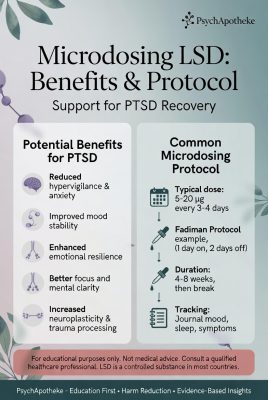
⚠️ Important Legal Notice: LSD is a Schedule I controlled substance in most countries, including the United States and Germany. This content is for educational purposes only and does not encourage or endorse illegal activity. Legal access to LSD is currently limited to approved clinical research trials.
Part 1: What Does the Science Say? : Proven Benefits of LSD Microdosing
Recent clinical research has begun to move beyond anecdotal reports, providing controlled evidence for the potential benefits of LSD microdosing.
1.1 Major Depressive Disorder (MDD) : The Strongest Evidence
The most robust research to date focuses on LSD microdosing for depression.
-
LSDDEP1 (Open-Label Pilot Trial, 2023): Seventeen participants with major depressive disorder completed an 8-week regimen of LSD microdosing (two doses per week). Qualitative interviews revealed five major thematic benefits:
-
Enhanced self-determination – Increased motivation to engage in daily activities
-
Increased connectedness – To self, others, and nature/world
-
Improved cognitive processing – Clearer thinking and personal insights
-
Better emotional well-being – Overall mood improvement and reduced depressive symptoms
-
Positive feedback loop – Each benefit reinforced the others, leading to cumulative positive change
-
-
LSDDEP2 (Ongoing Phase 2b RCT, 2024–present): This is the first randomized, double-blind, placebo-controlled trial of LSD microdosing for MDD in participants’ natural environments. Using a titratable formulation (MB-22001) with doses ranging from 4 to 20 μg taken twice weekly, this study will provide definitive efficacy data.
1.2 Neurobiological Mechanisms – How Microdosing Works
Controlled studies have identified several biological effects of small LSD doses:
| Effect | Finding | |
|---|---|---|
| BDNF increase | Single 5–20 μg dose acutely increases brain-derived neurotrophic factor (supports neuroplasticity) | |
| Brain connectivity | Increased amygdala–frontal cortex connectivity correlates with positive mood | |
| EEG changes | Reduced default mode network (DMN) activity similar to full-dose psychedelics but subtler | |
| Reward processing | Enhanced neural response to positive feedback (increased motivational salience) |
These findings suggest that microdosing may work by enhancing neuroplasticity and “rebalancing” brain networks involved in mood regulation, rather than through acute perceptual effects.
1.3 Additional Reported Benefits (Anecdotal + Emerging)
While controlled research is limited, large-scale naturalistic studies and self-reports consistently highlight:
-
Improved focus and productivity – Often compared to Adderall but without the side effects
-
Enhanced creativity – Reduced mental blocks and increased cognitive flexibility
-
Reduced anxiety – Both social anxiety and generalized anxiety
-
Better emotional regulation – Less reactivity and faster “reset” after conflicts
-
Healthier habits – Many users report improved sleep, diet, and exercise routines
📊 Note on placebo effects: Several placebo-controlled studies in healthy volunteers have failed to show significant objective improvements over placebo, despite strong subjective report. This highlights the importance of expectation and context in microdosing outcomes.
Part 2: The Fadiman Protocol – The Most Popular Microdosing Schedule
The Fadiman Protocol is the most widely used and referenced microdosing schedule, developed by Dr. James Fadiman, a pioneering psychedelic researcher.
2.1 The Standard Schedule
| Day | Action |
|---|---|
| Day 1 | Microdose in the morning |
| Day 2 | No dose (integration day effects still present) |
| Day 3 | No dose (baseline day no effects) |
| Day 4 | Microdose again (repeat cycle) |
Duration: Typically 4 to 8 weeks, followed by a break period of at least 2–4 weeks.
2.2 Dose Guidelines
A standard LSD microdose ranges from 5 to 20 micrograms (μg).
| Dose Level | Amount (μg) | Effect |
|---|---|---|
| Threshold | 4–10 μg | Barely perceptible , subtle mood lift |
| Standard microdose | 10–15 μg | Clear but sub-hallucinogenic , improved focus and mood |
| Upper microdose | 15–20 μg | May approach perceptual changes , use with caution |
📌 Important: Individual sensitivity varies significantly. The principle is “start low, go slow.” A dose that works for one person may be too strong or too weak for another.
2.3 Why Every Three Days?
The Fadiman protocol’s spacing serves three purposes:
-
Prevents tolerance buildup – LSD tolerance develops rapidly with daily use
-
Allows for self-observation – Comparing dose days vs. non-dose days helps users assess effects
-
Supports integration – The off days allow psychological benefits to be processed and integrated
2.4 Alternative Protocols
| Protocol | Schedule | Best For | Notes |
|---|---|---|---|
| Fadiman | Every 3 days | General wellness, depression, creativity | Most researched |
| Weekly | 1–2 times per week | Mild symptoms, maintenance | Lower tolerance risk |
| Weekend only | Sat & Sun | Workweek focus | Avoids workday dosing |
| Titration (clinical) | Twice weekly, adjustable 4–20 μg | Depression (in trials) | Medical supervision required |
Part 3: Safety, Risks, and Contraindications
No intervention is without risk. While LSD has a remarkably low physiological toxicity profile, microdosing carries important considerations.
3.1 Cardiac Risks (Theoretical but Important)
Both LSD and psilocybin are potent 5-HT2B receptor agonists the same receptor linked to valvular heart disease when chronically activated by drugs like fenfluramine
What we know:
-
The risk of heart valve damage from microdosing is theoretical no human cases have been documented
-
However, the 5-HT2B affinity of psychedelics is significant
-
Risk mitigation: Limit microdosing frequency (no more than 5 times per week) and duration (1 month on, 1 month off)
Absolute contraindications:
-
Personal history of heart disease or heart valve disorders
-
Major cardiac risk factors (uncontrolled hypertension, etc.)
-
Family history of valvular heart disease
💡 Recommendation: If you have any cardiac concerns, do not microdose without medical consultation.
3.2 Psychiatric Risks
| Risk | Details |
|---|---|
| Dosage mistakes | Accidental full-dose ingestion is common due to variable potency use test kits and accurate scales |
| Anxiety/paranoia | Even microdoses can trigger anxiety in susceptible individuals |
| Psychosis precipitation | Absolute contraindication for personal/family history of psychotic disorders |
| No effect for some | In the LSDDEP1 trial, some participants reported no change or negative effects |
3.3 Medication Interactions
Do not combine with:
-
SSRIs / SNRIs (antidepressants) – May blunt effects or increase serotonin toxicity risk
-
MAOIs – Dangerous interaction risk
-
Lithium – Increased risk of seizures and psychosis
-
Triptans (migraine medications) – Theoretical serotonin syndrome risk
3.4 Harm Reduction Best Practices
If you choose to microdose (where legal or with appropriate oversight):
✅ Do:
-
Use an accurate milligram scale and reagent test kit
-
Start with the lowest possible dose (4–5 μg)
-
Maintain a journal to track effects objectively
-
Take regular breaks (1 month on, 1 month off)
-
Have a sober sitter available for the first few doses
❌ Don’t:
-
Drive or operate heavy machinery on dose days
-
Combine with alcohol or other substances
-
Microdose daily without breaks
-
Ignore negative reactions stop if symptoms worsen
Part 4: Legal Status – Can You Legally Microdose LSD?
| Jurisdiction | Status |
|---|---|
| United States | Schedule I – illegal for personal use. Legal only in FDA-approved clinical trials |
| Germany / EU | Schedule I (BtMG in Germany) – illegal outside approved research |
| Canada | Schedule III – illegal without exemption |
| United Kingdom | Class A – illegal |
| Australia | Schedule 9 – prohibited (clinical trials only) |
Legal Access Pathways
The only legal way to access LSD microdosing is through approved clinical research trials. Examples include:
-
LSDDEP2 (Australia/New Zealand) – Recruiting for MDD
-
University of Chicago study – Investigating 26 μg doses for depression
🔍 Psychapotheke’s role: We provide education, clinical trial navigation, and harm-reduction resources to support informed, legal decision-making.
Part 5: Microdosing vs. Full-Dose Psychedelic Therapy
| Aspect | Microdosing | Full-Dose (Macrodose) |
|---|---|---|
| Dose | 5–20 μg | 100–200+ μg |
| Experience | Sub-perceptual to mild | Intense altered consciousness, ego dissolution |
| Frequency | Every 3 days for weeks | 1–3 sessions total |
| Setting | Normal daily activities | Therapeutic or ceremonial setting |
| Therapy integration | Self-guided | Usually with professional support |
| Evidence base | Emerging (RCTs ongoing) | Strong for PTSD, depression, end-of-life anxiety |
| Time commitment | Minimal | Full day per session |
Key distinction: Microdosing is often described as a “lifestyle” or “enhancement” practice, while full-dose therapy is a transformative, event-based treatment–.
Part 6: Frequently Asked Questions (FAQ)
Typically 30–90 minutes after ingestion. Effects last approximately 6–10 hours.
Yes. Tolerance develops rapidly with daily use. This is why the Fadiman protocol includes two non-dosing days between doses
LSD is not considered physically addictive. No withdrawal syndrome has been documented. However, psychological dependency is possible with any mood-altering substance.
Standard urine drug tests do not test for LSD. Specialized tests exist but are extremely rare and expensive
Generally not recommended. SSRIs may reduce or block effects, and there are theoretical serotonin syndrome risks. Consult a physician.
No. In the LSDDEP1 trial, some participants reported no improvement or negative side effects. Individual biology, psychology, and context all matter.
Part 7: Conclusion – What You Should Take Away
LSD microdosing is a promising but still experimental practice. The current evidence suggests:
✅ Potential benefits for mood, focus, connectedness, and depression symptoms — supported by emerging clinical trials
⚠️ Significant unknowns – Long-term safety data is lacking; placebo effects are substantial
🚫 Legal restrictions – LSD remains illegal for personal use in almost all countries
🔬 The future – Ongoing Phase 2b RCTs (LSDDEP2, University of Chicago) will provide definitive answers in the coming years
For Psychapotheke Readers
If you are interested in legal, evidence-based approaches to mental health and altered states:
-
Explore legal ketamine therapy (available by prescription)
-
Consider breathwork, meditation, or float therapy for non-pharmacological altered states
-
Monitor clinical trial listings for legal participation opportunities
-
Consult with a psychedelic integration coach (legal worldwide)
Our mission is education, safety, and science.
References
-
Donegan CJ, et al. (2025). What is it like to microdose LSD for depression? A thematic analysis. Therapeutic Advances in Psychopharmacology.
-
Hutten N, et al. (2021). Microdosing LSD: Acute effects on BDNF. Journal of Psychopharmacology.
-
Daldegan-Bueno D, et al. (2024). LSDDEP2: study protocol for an RCT of LSD microdosing in MDD. Trials.
-
Murphy RJ, et al. (2024). Microdosing Psychedelics: Current Evidence From Controlled Studies. Biological Psychiatry.
-
Fadiman J. (2011). The Psychedelic Explorer’s Guide.
Medical Disclaimer: This content is for educational purposes only and does not constitute medical advice. Always consult a licensed healthcare provider before making changes to your mental health treatment.
Legal Disclaimer: LSD is a controlled substance in most jurisdictions. Psychapotheke does not encourage or endorse illegal activity.