DMT Research: Mental Health Applications for PTSD, Depression & Beyond
An evidence‑based resource on the therapeutic potential of DMT
DMT Research At Psychapotheke, we are committed to providing accurate, science‑driven information about psychedelic‑assisted therapy. This page synthesizes the most current research on N,N‑Dimethyltryptamine (DMT) and its applications in mental health.
Legal and medical disclaimer: DMT remains a controlled substance in most countries. This content is for educational and research purposes only and does not constitute medical advice or an endorsement of illegal activity.
What Is DMT? A Brief Overview
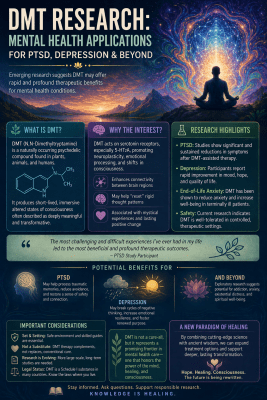
DMT is a naturally occurring tryptamine found in various plants and animals, and it is the primary psychoactive component of the traditional Amazonian brew ayahuasca. Chemically, DMT closely resembles the neurotransmitter serotonin, which allows it to interact with specific receptors in the brain.
Unlike many other classical psychedelics, DMT has a remarkably short duration of action—typically 10–20 minutes when vaporized or inhaled making it a unique candidate for scalable, time‑efficient psychiatric interventions.
DMT Research for Treatment‑Resistant Depression (TRD)
Groundbreaking Phase 2a Clinical Trial
One of the most significant recent advances in DMT research comes from a 2025 phase 2a clinical trial that evaluated vaporized DMT for treatment‑resistant depression a condition affecting approximately one‑third of the more than 185 million people worldwide living with depression.
In this open‑label, dose‑escalation study, 14 patients with moderate‑to‑severe TRD inhaled two escalating doses of DMT (15 mg followed by 60 mg) in a supportive clinical environment. The results were striking:
-
Rapid onset: A significant reduction in depressive symptoms was observed within 24 hours of administration–.
-
Sustained relief: The antidepressant effect persisted for up to three months after a single day of treatment.
-
High response and remission rates: By day 7, 71% of participants responded to treatment (≥50% reduction in depression scores), and 14% achieved remission.
-
Reduction in suicidal ideation: Severe suicidal thoughts vanished within a day and remained significantly lower throughout the follow‑up period.
The treatment was safe and well tolerated, with no serious adverse events reported. Most side effects such as mild throat discomfort or coughing during inhalation were transient.
Why DMT for Depression?
Vaporized DMT offers several practical advantages over other psychedelics being studied for depression:
-
Short treatment sessions: Unlike psilocybin or LSD sessions that can last 4–12 hours, DMT sessions typically require only 30–60 minutes of clinical supervision.
-
Compatibility with existing medications: DMT does not require patients to discontinue standard antidepressants, enhancing both safety and practicality.
-
Scalability and accessibility: The shorter duration and non‑invasive administration make DMT more easily integrated into public health systems at lower cost.
A systematic review of early‑phase DMT trials, published in 2025, confirmed a favorable safety profile across multiple routes of administration, with no serious adverse events reported and only mild, transient effects such as dose‑dependent cardiovascular changes, throat discomfort, or nausea.
DMT Research for Post‑Traumatic Stress Disorder (PTSD)
Preclinical and Observational Findings
While the evidence base for DMT in PTSD is less extensive than for depression, preliminary studies are promising. DMT is thought to be particularly helpful for internalizing disorders such as PTSD, depression, and addiction in which negative thought patterns are reinforced repeatedly.
Ibogaine / 5‑MeO‑DMT in Veterans
A prospective study evaluated the combination of ibogaine and 5‑MeO‑DMT (a closely related, more potent analog of DMT) for co‑occurring alcohol misuse and PTSD symptoms among US Special Operations Forces veterans. The results suggested that this treatment approach may be effective for individuals who have not responded to conventional therapies–.
Ongoing Clinical Trials
A growing number of registered clinical trials are now specifically investigating DMT and its analogs for PTSD:
-
The Trifecta Research Study (clinical trial registration) is examining ibogaine and 5‑MeO‑DMT in the treatment of post‑traumatic stress disorder and traumatic brain injury‑related cognitive symptoms–.
-
Additional trials are exploring 5‑MeO‑DMT for PTSD, with early findings indicating that the compound is generally tolerable, safe to administer, and effective for PTSD symptoms, though side effects such as acute nausea and transient sleep disturbances have been noted–.
Proposed Mechanism
DMT and related psychedelics appear to help disrupt entrenched neurobiological patterns associated with trauma, addiction, and depression. By inducing a temporary state of neural disorganization, these compounds may allow the brain to “reset” maladaptive circuits, thereby increasing the effectiveness of concurrent psychotherapy.
The Neurobiological Mechanism of DMT
Serotonin Receptor Activation
Like other classical psychedelics, DMT produces its psychoactive effects primarily by agonizing the serotonin 2A (5‑HT₂A) receptor. However, DMT also activates 5‑HT₁A receptors a validated therapeutic target for treating depression and anxiety which may contribute to its unique therapeutic profile–.
Neuroplastogen Properties
Emerging research has redefined DMT as a neuroplastogen: a compound that promotes neuroplasticity the brain’s ability to reorganize and form new neural connections. DMT binds to intracellular sigma‑1 receptors and 5‑HT₂A receptors, stimulating processes that may underlie its long‑lasting antidepressant effects–.
Lack of Tolerance
One of DMT’s most distinctive features is its lack of tachyphylaxis (rapid tolerance development). Unlike other serotonergic psychedelics, DMT does not produce significant tolerance with repeated use, suggesting a distinct pharmacological mechanism that makes it a valuable tool for psychopharmacological research.
Safety and Tolerability: What the Data Show
A 2025 systematic review conducted following PRISMA guidelines and registered with the Open Science Framework synthesized safety data from five early‑phase clinical trials involving DMT in healthy volunteers and patients with major depressive disorder. Key findings include:
-
No serious adverse events were reported across any route of administration (intravenous, inhaled, oral, intranasal).
-
Dose‑dependent cardiovascular effects (increased systolic blood pressure and heart rate) were observed but resolved quickly.
-
Psychotomimetic effects including ego dissolution and mystical‑type experiences were dose‑dependent but manageable within a clinical setting.
-
Mild side effects such as throat discomfort, coughing, nausea, and dizziness were short‑lived.
A separate randomized, double‑blind, placebo‑controlled trial published in 2025 confirmed that inhaled DMT is safe, well tolerated, and capable of inducing profound altered states of consciousness without significant clinical risks. Adverse events were predominantly mild and transient.
DMT Analogues and Ongoing Clinical Trials
5‑MeO‑DMT
The more potent analog 5‑methoxy‑N,N‑dimethyltryptamine (5‑MeO‑DMT) has attracted significant research interest. Observational studies suggest that a single exposure to 5‑MeO‑DMT can cause rapid and sustained reductions in symptoms of depression, anxiety, and stress. It also appears to stimulate neuroendocrine function, immunoregulation, and anti‑inflammatory processes, which may contribute to improved mental health outcomes–.
In October 2025, the US Food and Drug Administration granted Breakthrough Therapy Designation to BPL‑003, an intranasal formulation of 5‑MeO‑DMT for treatment‑resistant depression. This designation expedites the development and review of drugs for serious or life‑threatening conditions–.
CYB004 (Deuterated DMT)
Cybin Inc. is advancing CYB004, a deuterated (chemically stabilized) form of DMT, through phase 2 clinical trials for generalized anxiety disorder (GAD). Results are expected in mid‑2025–.
Registered Trials
The landscape of psychedelic clinical trials continues to expand rapidly. A 2025 landscape analysis of pre‑registered clinical trials identified numerous ongoing investigations involving DMT, 5‑MeO‑DMT, LSD, and psilocybin for conditions including major depressive disorder, PTSD, anxiety disorders, and substance use disorders–.
DMT‑Assisted Therapy: The Clinical Model
DMT‑assisted therapy follows the same general framework as other psychedelic‑assisted treatments:
-
Preparation sessions – Patients meet with a therapist to establish intention, build rapport, and prepare for the psychedelic experience.
-
Dosing session – DMT is administered (typically via vaporization or intranasal spray) in a comfortable, supervised environment. The acute effects last approximately 15–30 minutes, followed by a brief period of clinical observation.
-
Integration sessions – In the days and weeks following the dosing session, patients work with a therapist to process and integrate insights gained during the experience into their daily lives.
Because the DMT experience is brief, a single dosing day may accommodate multiple sessions or be combined with other therapeutic modalities, potentially improving scalability and reducing costs.
Regulatory Landscape and Future Directions
Current Legal Status
DMT is classified as a Schedule I controlled substance in the United States and as a non‑tradeable narcotic under Germany’s Betäubungsmittelgesetz (BtMG). Outside of approved clinical research, possession, sale, or personal use remains illegal. However, the regulatory environment is evolving rapidly, with the FDA clearing multiple investigational new drug (IND) applications for DMT and 5‑MeO‑DMT in 2025 and 2026.
Toward Clinical Implementation
A 2026 narrative review of psychedelic‑assisted pharmacotherapy concluded that while late‑stage trials support the potential of DMT and related compounds in high‑need populations, unresolved challenges including long‑term safety data, scalability, workforce training, and equitable access must be addressed before broader clinical implementation.
Research in Germany and Europe
In Germany, the Deutsches Zentrum für Psychische Gesundheit (DZPG) is actively investigating LSD and 5‑MeO‑DMT to improve therapeutic outcomes for depression, generalized anxiety disorder, and addiction. Early clinical applications show promise. Across Europe, more than 700 patients with depression, PTSD, and anxiety disorders have received psychedelic‑assisted treatments in clinical trials as of 2024–.
Key Takeaways from Current DMT Research
| Condition | Key Findings |
|---|---|
| Treatment‑Resistant Depression | Vaporized DMT produced rapid (within 24 h) and sustained (up to 3 months) antidepressant effects in a phase 2a trial, with high response (71%) and remission (14%) rates at day 7. |
| PTSD | Observational studies and ongoing trials suggest DMT and 5‑MeO‑DMT may reduce PTSD symptoms, particularly in treatment‑resistant populations, by disrupting entrenched trauma‑related neural patterns–. |
| Safety | Systematic reviews confirm a favorable safety profile with no serious adverse events reported in early‑phase trials. Mild, transient side effects are dose‑dependent. |
| Mechanism | DMT acts as a neuroplastogen, promoting neuroplasticity via 5‑HT₂A, 5‑HT₁A, and sigma‑1 receptors. Its lack of tolerance distinguishes it from other psychedelics. |
| Regulatory Progress | FDA Breakthrough Therapy Designation granted to 5‑MeO‑DMT (BPL‑003) for TRD in 2025. Multiple IND applications cleared for DMT analogs in 2025‑2026. |
Frequently Asked Questions
No. DMT remains a controlled substance in most countries and is not approved for routine clinical use. However, it can be administered to eligible participants within approved clinical trials.
The primary difference is duration of action. DMT’s acute effects last approximately 10–30 minutes, compared to 4–12 hours for psilocybin or LSD. This shorter duration may allow for more scalable, time‑efficient, and cost‑effective treatment models
Current DMT research focuses primarily on treatment‑resistant depression, PTSD, generalized anxiety disorder, and substance use disorders. Preliminary evidence also suggests potential applications for end‑of‑life distress and certain mood disorders
Clinical trial availability varies by country and institution. Interested individuals should consult the clinicaltrials.gov registry or contact local research institutions to identify ongoing studies and eligibility criteria.
Early‑phase clinical trials consistently report that DMT is safe and well tolerated when administered in controlled, medically supervised settings. No serious adverse events have been reported across multiple trials. However, DMT should never be used outside of a clinical or research settings
Final Thoughts
The body of evidence supporting DMT as a potential treatment for serious mental health conditions—particularly treatment‑resistant depression and PTSDnis growing rapidly. From its unique neuroplastogenic mechanism of action to its favorable safety profile and practical advantages in clinical administration, DMT represents a distinct and promising avenue in the evolving field of psychedelic‑assisted therapy.
At Psychapotheke, we remain committed to tracking the latest developments in this space and providing our community with accurate, up‑to‑date, and scientifically grounded information.
References
-
Falchi‑Carvalho, M., Palhano‑Fontes, F., Wießner, I., et al. (2025). Rapid and sustained antidepressant effects of vaporized N,N‑dimethyltryptamine: a phase 2a clinical trial in treatment‑resistant depression. Neuropsychopharmacology, 50, 895–903.
-
Safety and tolerability of NN‑dimethyltryptamine (DMT) in healthy volunteers and Major Depressive Disorder (MDD) patients: A systematic review of early‑phase clinical trials. (2025). Journal of Psychiatric Research.
-
Wießner, I., et al. (2025). Safety, tolerability and subjective effects of vaporized N,N‑Dimethyltryptamine: A randomized double‑blind clinical trial. European Neuropsychopharmacology, 97, 16–27.
-
Why N,N‑dimethyltryptamine matters: unique features and therapeutic potential beyond classical psychedelics. (2024). Frontiers in Psychiatry, 15, 1485337.
-
Marazziti, D., et al. (2026). Psychedelic‑assisted pharmacotherapy: clinical applications and regulatory considerations. Expert Opinion on Pharmacotherapy.
-
Prospective associations of psychedelic treatment for co‑occurring alcohol misuse and posttraumatic stress symptoms among United States Special Operations Forces Veterans. (2024). Journal of Traumatic Stress.–
-
FDA Breakthrough Therapy Designation for BPL‑003 (5‑MeO‑DMT) in treatment‑resistant depression. (2025). Psychedelic Alpha Bulletin.–