

LSD Safety: A Comprehensive Harm Reduction Guide
Disclaimer: LSD is an illegal Schedule I substance in most countries, including Germany, the US, and the UK. Psychapotheke does not encourage or endorse illegal drug use. This guide is for LSD Safety: harm reduction guide, to reduce risks for those who choose to use despite legal prohibitions.
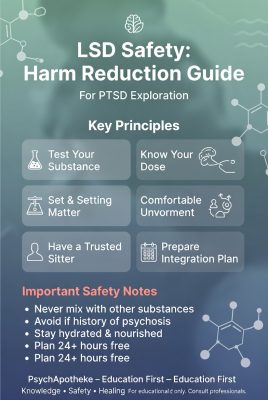
Introduction: Why Harm Reduction Matters
Over 1.5 million adults in Germany alone report having used a classic psychedelic at least once in their lifetime. Despite legal status, LSD use continues.
Prohibition does not eliminate use it drives it underground, where risks increase due to:
-
Unknown purity and dosage
-
Lack of medical supervision
-
No access to professional support during difficult experiences
Harm reduction is the pragmatic, evidence-based approach to reducing negative consequences when absolute prevention is unrealistic.
This guide covers:
-
✅ What LSD is and how it works
-
✅ Safe dosage guidelines
-
✅ Set, setting, and trip sitting
-
✅ Mental health risks and contraindications
-
✅ Testing your substance
-
✅ Navigating a difficult trip (bad trip)
-
✅ Integration after the experience
Part 1: What Is LSD? (Brief Pharmacology)
LSD (Lysergic acid diethylamide) is a potent serotonergic psychedelic. It primarily acts on the 5-HT2A serotonin receptor, altering connectivity between brain regions.
| Property | Detail |
|---|---|
| Onset | 20–60 minutes |
| Peak | 2–4 hours |
| Total duration | 8–12 hours |
| Typical dose | 50–200 micrograms (µg) |
| Tolerance | Builds rapidly; returns to baseline after 7–14 days |
⚠️ Important: LSD is active at extremely low doses. A standard blotter contains 100–150 µg. Doses above 400 µg significantly increase risk of psychological distress.
Part 2: Know Your Risks: Who Should NOT Use LSD
LSD is not for everyone. The following groups face significantly elevated risks:
❌ Absolute contraindications:
-
Personal or family history of psychosis (schizophrenia, bipolar I with mania)
-
First-degree relative with a psychotic disorder
-
Current suicidal ideation without professional support
-
Age under 21 (developing brain)
⚠️ Relative contraindications (consult a doctor first):
-
Taking SSRIs, SNRIs, or MAOIs (risk of serotonin syndrome or blunted effects)
-
Heart conditions (LSD raises blood pressure and heart rate)
-
Pregnancy or breastfeeding
-
History of seizures
📌 Bottom line: If you have a personal or family history of psychosis, do not use LSD. The risk of triggering a long-term psychotic disorder is real and well-documented.
Part 3: Set & Setting : The Most Important Safety Factor
Set = Your mindset (thoughts, mood, expectations)
Setting = Your physical and social environment
These two factors determine 80% of your experience quality.
✅ Optimal set (mindset):
-
Calm, stable mood for at least 24 hours
-
No recent major life crises (breakup, job loss, death in family)
-
Clear intention (e.g., self-exploration, creativity not escaping pain)
-
Well-rested and well-hydrated
✅ Optimal setting (environment):
-
Familiar, safe, private space (home or trusted friend’s home)
-
No unexpected visitors or obligations
-
Soft lighting, comfortable seating (couch, floor cushions, bed)
-
Access to water, light snacks, bathroom
-
Music playlist prepared (calm, instrumental, familiar)
❌ Dangerous settings to avoid:
-
Crowded public places (concerts, clubs, festivals)
-
Near water (drowning risk), balconies, or traffic
-
With strangers or untrusted people
-
During family obligations or work responsibilities
Part 4: Dosage Guidelines : Start Low, Go Slow
LSD dose is measured in micrograms (µg) . One blotter = 100–150 µg typically.
| Dose | Experience Level | Effects |
|---|---|---|
| 20–50 µg | Microdose / Threshold | Subtle mood lift, focus; no visuals |
| 50–80 µg | Low | Mild visual changes, heightened awareness |
| 80–120 µg | Standard | Full psychedelic experience; moderate visuals, time distortion |
| 120–200 µg | Strong | Intense visuals, ego dissolution possible |
| 200–400 µg | Heavy | High risk of challenging experience; not recommended for beginners |
| 400+ µg | Extreme | High risk of psychotic reactions; avoid |
🧪 If you have unknown dosage: Assume it is high. Take half a tab or less on your first experience with that batch.
Part 5: Testing Your Substance : Non-Negotiable
Street LSD is often fake or adulterated. Common substitutes include:
-
NBOMe series (25I-NBOMe, etc.) can cause seizures and death at standard doses
-
DOx compounds last 16–30 hours, dangerous for some
-
Nothing just paper with no active ingredient
✅ How to test (legally available kits):
| Test Kit | What It Detects |
|---|---|
| Ehrlich reagent | Confirms presence of an indole (LSD or similar) |
| Hofmann reagent | Distinguishes LSD from other indoles |
| Marquis reagent | Detects NBOMe and other adulterants |
📦 Where to buy: Reagent test kits are legal in most countries (sold as “research chemicals testing kits”).
Testing protocol:
-
Cut a tiny corner (1/16th) of the blotter
-
Place on ceramic plate
-
Add 1 drop of reagent
-
Read color change per kit instructions
If Ehrlich turns purple → indole present (good sign).
If no color change or different color → not LSD. Do not consume.
Part 6: Trip Sitting : The Role of a Sober Guide
A trip sitter is a sober, trusted person who stays with you for the full 8–12 hours.
What a good trip sitter does:
-
✅ Stays calm and sober
-
✅ Remains in the same room or nearby
-
✅ Reminds you “this will end” during difficult moments
-
✅ Helps with basic needs (water, bathroom, temperature)
-
✅ Calls emergency services if needed (see Part 8)
What a trip sitter should NOT do:
-
❌ Use substances themselves
-
❌ Leave unexpectedly
-
❌ Argue, lecture, or panic
-
❌ Touch you without consent
🧠 Pro tip: The sitter should read a guide like The Psychedelic Explorer’s Guide (James Fadiman) beforehand.
Part 7: Navigating a Difficult Trip (The “Bad Trip”)
Difficult experiences are common, especially at higher doses. Most pass within hours. Here is how to handle them.LSD Safety: harm reduction guide
For the person experiencing distress:
-
Change your setting — move to a different room, change lighting, change music
-
Change your position — sit up, lie down, stand, walk slowly
-
Focus on your breath — inhale for 4 seconds, hold for 4, exhale for 6
-
Repeat a grounding phrase: “I took a drug. It will end. I am safe.”
-
Ask for a blanket or water — physical comfort helps
For the trip sitter (if person is panicking):
-
Speak slowly, calmly, softly
-
Do not say: “Calm down” (this backfires)
-
Do say: “You are safe. I am here. This is temporary. Breathe with me.”
-
Offer water or a blanket
-
Remove stressful stimuli (loud music, bright lights, strangers)
-
Do not restrain unless immediate danger (self-harm)
🚨 When to call emergency services:
-
Person is violent (danger to self or others)
-
Person has seizure
-
Person loses consciousness
-
Person expresses suicidal intent and cannot be redirected
-
Body temperature above 40°C (104°F) (rare, but possible with adulterants)
📞 In AMERICA: Emergency number 911. Tell them: “Someone is having a severe drug reaction. No violence. Please send an ambulance.” You will not be arrested for seeking medical help in most EU countries (Good Samaritan laws apply).
Part 8: Drug Interactions: Dangerous Combinations
LSD is relatively safe pharmacologically, but combinations can be dangerous.
| Substance | Risk with LSD | Recommendation |
|---|---|---|
| Alcohol | Reduced awareness; poor decisions | Avoid |
| Cannabis | Massive increase in anxiety, paranoia, psychosis risk | Avoid until after peak (if at all) |
| SSRIs / SNRIs | Blunted effects or serotonin syndrome risk | Avoid |
| MAOIs | Potentially dangerous serotonin toxicity | Never combine |
| Lithium | Seizures, psychosis | Never combine |
| Tramadol | Seizure risk | Avoid |
| Stimulants (amphetamine, cocaine) | Extreme anxiety, heart strain | Avoid |
💀 Most dangerous combinations: LSD + Lithium or LSD + MAOIs can be fatal. Do not risk it.
Part 9: After the Experience: Integration
What happens after LSD is as important as what happens during.
Immediate aftercare (next 24 hours):
-
Rest and sleep (your brain needs recovery)
-
Hydrate and eat light, nutritious food
-
Avoid cannabis, alcohol, or other drugs
-
Do not make major life decisions (relationships, jobs, moves)
Longer-term integration (days to weeks):
-
Journal about your experience (what did you feel, see, learn?)
-
Talk to a trusted friend or integration coach
-
Draw, paint, or make music to express nonverbal insights
-
Consider professional integration therapy (legal, available online)
🧠 What is integration? The process of making sense of psychedelic experiences and applying insights to daily life. Without integration, even profound experiences fade without change.
Signs you may need professional support:
-
Persistent anxiety or confusion lasting >1 week
-
Flashbacks or intrusive memories
-
Difficulty returning to work or relationships
-
New or worsening depression
📌 Psychapotheke offers vetted referrals to licensed integration coaches and therapists.
Part 10: Legal Reminder & Good Samaritan Laws
| Country | LSD Legal Status | Good Samaritan Law |
|---|---|---|
| Germany | Illegal (BtMG Schedule I) | ✅ Yes no prosecution for seeking medical help during an emergency |
| United States | Schedule I | Varies by state (most have some protection) |
| United Kingdom | Class A | ⚠️ Limited protection |
| Canada | Schedule III | ✅ Yes |
| Netherlands | Illegal (but tolerated in low doses) | ✅ Yes |
📌 If someone is in medical distress, always call emergency services. No one has ever been prosecuted for saving a life in Germany, the Netherlands, or most US states.LSD Safety: harm reduction guide
Summary: LSD Safety Checklist
Before using LSD, check every box:
-
No personal or family history of psychosis
-
Not taking SSRIs, MAOIs, lithium, or tramadol
-
Tested with Ehrlich reagent (positive for indole)
-
Dose known and moderate (≤150 µg for first time)
-
Sober, trusted trip sitter arranged
-
Safe, private, familiar environment
-
No obligations for 12+ hours
-
Calm mindset (no recent crisis)
-
Water, snacks, music, blanket prepared
-
Emergency contact or phone nearby
Frequently Asked Questions
Rarely, but yes — in predisposed individuals. If you have a family history of schizophrenia or bipolar disorder, LSD can trigger a first psychotic episode that may become chronic
No. LSD is not considered addictive. It does not cause compulsive redosing, and tolerance builds immediately. However, psychological dependence is possible (rare).
No. Tolerance builds so rapidly that the second day would require 3–5x the dose for minimal effects. Wait at least 7–14 days
Hallucinogen Persisting Perception Disorder — rare condition where visual distortions (tracers, halos) persist weeks or months after use. More common with high doses or frequent use.
Final Word from Psychapotheke
We are a legal, science-based platform dedicated to psychedelic education, harm reduction, and mental health support.
LSD is not a toy. It is a powerful tool that demands respect, preparation, and caution.
If you choose to use despite legal prohibitions, this guide exists to help you survive and maybe even benefit.
The safest dose is zero.
The second safest is informed, tested, and supported.
Psychapotheke — Knowledge saves lives.
Medical & Legal Disclaimer
This guide is for harm reduction education only and does not constitute medical advice. Always consult a licensed physician before making decisions about your health. LSD is illegal in most jurisdictions. Psychapotheke does not encourage or endorse illegal activity.