What Is DMT? The Spirit Molecule Fully Explained
Dimethyltryptamine (DMT) has been called the most powerful psychedelic known to science. It is also known as “The Spirit Molecule” a nickname popularized by Dr. Rick Strassman’s groundbreaking research in the 1990s.
But what exactly is DMT?
Where does it come from?
Why is it called the Spirit Molecule?
And can it help with conditions like PTSD?
This guide answers all of those questions with science, clarity, and respect for both the molecule and the law.
Part 1: What Is DMT? (The Simple Definition)
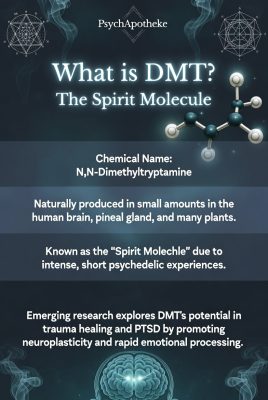
DMT (Dimethyltryptamine) is a naturally occurring psychedelic compound found in hundreds of plants and animals including the human body.
-
Chemical classification: Tryptamine alkaloid
-
Structure: Similar to serotonin (the brain’s “happiness” chemical)
-
Origin: Found in ayahuasca, mimosa hostilis, and even mammalian brains
Unlike other psychedelics that last for hours (like LSD or psilocybin), smoked or vaped DMT produces an intense, 5–20 minute experience often described as “breaking through” into another reality.
🔬 Key fact: Dimethyltryptamine is one of the fastest-acting and shortest-lasting powerful psychedelics known.
Part 2: Why Is DMT Called “The Spirit Molecule”?
The nickname “The Spirit Molecule” comes from Dr. Rick Strassman’s 2001 book of the same name.
Between 1990 and 1995, Dr. Strassman conducted the first FDA-approved human psychedelic research in decades using intravenous Dimethyltryptamine at the University of New Mexico.
What participants reported:
-
Contact with intelligent, non-human entities
-
Visits to otherworldly realms
-
Profound spiritual or mystical experiences
-
Encounters that felt more real than everyday reality
Strassman hypothesized that DMT might be released naturally by the pineal gland during birth, dreaming, death, and deep meditation though this remains unproven.
🌌 The Spirit Molecule refers not just to the chemical, but to the mystical and transcendent experiences it unlocks.
Part 3: The Science: How Does DMT Work in the Brain?
DMT primarily affects the brain’s serotonin 2A receptors (5-HT2A) the same receptors targeted by LSD, psilocybin, and mescaline.
Known effects on brain function:
| Brain Region | Effect |
|---|---|
| Default Mode Network (DMN) | Suppressed (quiets the ego) |
| Visual cortex | Hyperactivity (intense visuals) |
| Limbic system | Emotional amplification |
| Thalamus | Altered sensory gating |
🧠 In plain English: DMT temporarily “turns off” the brain’s normal filtering system, allowing information to flow in ways it normally cannot.
Neuroplasticity:
Emerging research suggests Dimethyltryptamine promotes neuroplasticity the brain’s ability to form new connections. This is why scientists are studying it for PTSD, depression, and addiction.
Part 4: DMT Effects: What Does a DMT Experience Feel Like?
Users consistently describe a predictable sequence:
1. Onset (seconds)
-
Buzzing or vibrating sound
-
Visual patterns (geometric, colorful)
2. Breakthrough (1–2 minutes)
-
Complete loss of body awareness
-
Entering a “waiting room” or tunnel of light
-
Encountering beings, entities, or other dimensions
3. Peak (3–10 minutes)
-
Intense emotional and visual content
-
Often described as “more real than reality”
-
Communication with non-human intelligences (for some)
4. Return (5–15 minutes)
-
Rapid return to normal awareness
-
Deep sense of meaning or confusion
-
Often followed by tears, laughter, or silence
⚠️ Important: Effects vary wildly by dose, set, setting, and individual brain chemistry.
Part 5: DMT vs LSD: Key Differences
Many people confuse DMT with LSD. Here is the breakdown:
| Feature | DMT | LSD |
|---|---|---|
| Duration | 5–20 minutes (smoked) | 6–12 hours |
| Intensity | Extremely intense | Intense but gradual |
| Entity contact | Common | Rare |
| Oral activity | No (requires MAOI) | Yes |
| Natural source | Yes (plants, animals) | No (semi-synthetic) |
| Research for PTSD | Early stages | Advanced stages |
📖 Learn more: LSD vs DMT for PTSD which is being studied more?
Part 6: DMT & PTSD: What Does the Research Say?
DMT is being actively studied for Post-Traumatic Stress Disorder (PTSD) , though less extensively than psilocybin or MDMA.
Why DMT might help PTSD:
-
Rapidly disrupts fear memory consolidation
-
Increases emotional processing during therapy
-
Promotes neuroplasticity in trauma-affected brain regions
-
Short duration allows for multiple sessions in a single day
Current research status:
-
Human studies: Limited but growing (Imperial College London, Johns Hopkins, University of São Paulo)
-
Animal studies: Promising for fear extinction
-
Legal barrier: Schedule I status slows research
🔬 Bottom line: Dimethyltryptamine is in process an approved PTSD treatment. As early science suggests it deserves serious investigation.
Part 7: Ayahuasca vs Smoked DMT
Many people ask: Is ayahuasca the same as DMT?
No. Ayahuasca is a brew containing DMT plus MAOIs (from the ayahuasca vine) that make DMT orally active.
| Feature | Smoked/Vaped DMT | Ayahuasca |
|---|---|---|
| Duration | 5–20 minutes | 4–8 hours |
| Intensity | Explosive peak | Gradual, wave-like |
| Nausea | None | Common (purge) |
| Setting | Anywhere | Ceremonial typically |
| Legal status | Illegal (most countries) | Legal for religious use (some countries) |
🌿 Ayahuasca is not legal in Germany or the US outside approved religious exemptions (very rare) or clinical research.
Part 8: Is DMT Legal?
For personal or recreational use.
| Country | Legal Status |
|---|---|
| Germany | Schedule I (BtMG) — illegal |
| United States | Schedule I — illegal |
| United Kingdom | Class A — illegal |
| Canada | Schedule III — illegal |
| Australia | Schedule 9 — prohibited |
Legal exceptions (only):
-
Government-approved clinical research
-
Rare religious exemptions (e.g, Brazil, some US Native American Church context for ayahuasca)
Part 9: The Risks of DMT
DMT is not physically toxic or addictive in the classical sense. But risks are real.
Psychological risks:
-
Bad trips (fear, panic, retraumatization)
-
Psychotic break (especially if family history of psychosis)
-
HPPD (Hallucinogen Persisting Perception Disorder rare but possible)
-
Unprocessed trauma surfacing without therapeutic support
Physical risks:
-
Increased heart rate and blood pressure
-
Nausea (especially with ayahuasca)
-
Dangerous behavior if taken alone
🧘 Harm reduction: DMT should never be used alone, without screening, or without a sober sitter.
Part 10: The Spirit Molecule Summary
| Question | Answer |
|---|---|
| What is DMT? | A powerful, short-acting psychedelic found in nature and the human body |
| Why “Spirit Molecule”? | Because users report spiritual and entity contact experiences |
| Is it legal? | Schedule I in most countries |
| Can it help PTSD? | Possible research is early but promising |
| Should I try it? | Only in legal clinical trials or with extreme harm reduction |
Final Word from Psychapotheke
The Spirit Molecule is one of the most fascinating compounds in existence.
It has the power to induce profound mystical states, challenge our understanding of consciousness, and potentially help heal trauma.
But power requires respect.
At Psychapotheke, we believe in:
-
✅ Science-first education
-
✅ Legal and ethical exploration
-
✅ Harm reduction for those who choose to explore
-
❌ Never facilitating illegal access
If you are interested in DMT for PTSD or personal growth, we encourage you to:
-
Read the research (Strassman, 2001; Timmermann et al., 2023)
-
Explore legal alternatives (ketamine therapy, breathwork, integration coaching)
-
Never break the law or risk your safety
Psychapotheke Understanding the Spirit Molecule, legally and scientifically.
Frequently Asked Questions (FAQ)
Yes. It is found in hundreds of plants and in trace amounts in mammals — including humans.
yes for personal use anywhere in the EU, US, UK, Canada, or Australia with a valid prescription.
Unproven. Dr. Strassman hypothesized this, but direct evidence is lacking.
No. It does not create physical dependence. Psychological addiction is extremely rare.
A complete loss of reality as we know it — often described as entering another dimension.
Possibly. Early research is promising, approved treatments exist.
📚 References (Abridged)
-
Strassman, R. (2001). DMT: The Spirit Molecule
-
Timmermann, C. et al. (2023). DMT and the brain. PNAS
-
Nichols, D. (2016). Psychedelics and PTSD. Pharmacological Reviews
-
Bogenschutz, M. & Ross, S. (2018). Psychedelic-assisted therapy for addiction and PTSD.
Medical disclaimer: This content is for educational purposes only. DMT is illegal in most jurisdictions. Always consult a licensed healthcare provider for mental health treatment.
Legal disclaimer: Psychapotheke doesn’t facilitate access to DMT or any illegal substance.