

LSD Dosage Guide: A Research-Based Guide to Safe Dosing
Last Updated: April 9th 2026
Lysergic acid diethylamide (LSD) is one of the most potent psychoactive substances known to science. Active at just 20 micrograms roughly equivalent to a few grains of salt LSD Dosage produces profound alterations in consciousness, perception, and mood that can last 8 to 12 hours .
Understanding proper dosage is critical for anyone considering LSD use, whether for therapeutic exploration, personal growth, or clinical research participation. This guide provides evidence-based dosage information, safety considerations, and harm-reduction strategies.
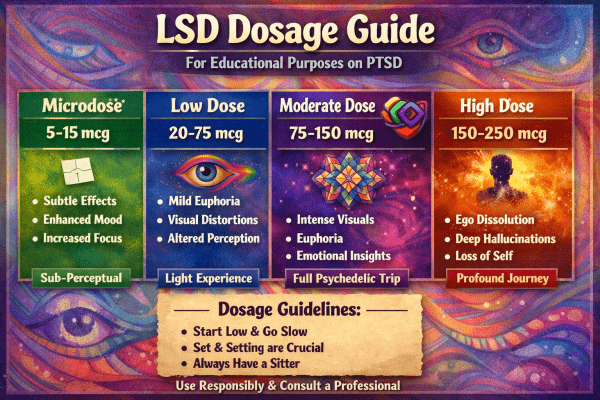
⚠️ Important Disclaimer: This guide is for educational and harm-reduction purposes only. LSD remains a controlled substance in most countries, including Germany, the United States, and the United Kingdom. Psychapotheke does not encourage or facilitate illegal drug use.
Part 1: How LSD Dosage Is Measured
LSD potency is measured in micrograms (µg) one-millionth of a gram. For perspective:
| Measurement | Equivalent |
|---|---|
| 1 microgram (µg) | 0.000001 gram |
| 20 µg | ~2–3 grains of table salt |
| 100 µg | ~1/10th of a milligram |
Unlike many other substances, LSD’s active dose is extraordinarily small. This makes accurate dosing difficult with street-purchased products, as variability between batches can be extreme .
Part 2: LSD Dosage Levels (Quick Reference)
Based on data from clinical research and harm-reduction organizations, the following Lsd dosage ranges apply to pure LSD:
| Dosage Level | Range (µg) | Effects |
|---|---|---|
| Microdose | 5–20 µg | Sub-perceptual; subtle mood, energy, or creativity shifts; no full psychedelic effects |
| Threshold | 15–30 µg | Mild perceptual changes; slight visual distortions or mood elevation |
| Light | 30–75 µg | Noticeable visual and cognitive effects; enhanced colors; mild euphoria |
| Common | 75–150 µg | Full psychedelic experience; vivid visuals; time distortion; emotional depth |
| Strong | 150–250 µg | Intense visuals; ego softening; profound cognitive shifts; potential for anxiety |
| Heavy | 250+ µg | Overwhelming for most users; complete ego dissolution; high risk of difficult experience |
Part 3: Microdosing (5–20 µg)
What Is Microdosing?
Microdosing involves taking sub-perceptual doses of LSD amounts too small to produce full psychedelic effects. Users typically follow a schedule of one dose every third day or twice weekly.
Latest Clinical Research (2025–2026)
A groundbreaking Phase 2A clinical trial (LSDDEP1) published in Neuropharmacology (February 2026) investigated microdosed LSD for major depressive disorder:
Study design:
-
19 participants with moderate depression
-
16 doses over 8 weeks (twice weekly at home)
-
Starting dose: 8 µg, titrated to 6–20 µg
-
First dose administered under clinical supervision
Key findings:
-
59.5% reduction in depression scores by end of treatment
-
Improvements sustained for up to six months
-
No serious or severe adverse events
-
First study to use echocardiography no valvulopathy detected after 16 doses
-
One participant withdrew due to anxiety during dosing
Dosage protocol used in the study:
-
Initial dose: 8 µg
-
Subsequent doses: 6–20 µg (individual titration)
-
Frequency: Twice weekly
-
Route: Sublingual (held ~30 seconds before swallowing)
Reported Effects of Microdoses (5–20 µg)
Clinical studies have documented the following acute effects at microdose levels :
| Dose | Observed Effects |
|---|---|
| 5 µg | Generally sub-perceptual; minimal noticeable effects in controlled studies |
| 10 µg | Mild mood elevation; subtle changes in energy and creativity |
| 20 µg | Noticeable effects in most individuals; altered time perception; increased emotional sensitivity |
📌 Important: Even at 20 µg, effects are noticeable but not fully psychedelic. The threshold for substantial perceptual changes begins around 30–50 µg .
Part 4: Light to Common Doses (30–150 µg)
Light Dose (30–75 µg)
This range produces mild to moderate psychedelic effects suitable for first-time users or those seeking gentle exploration.
Typical effects:
-
Enhanced visual perception (brighter colors, subtle patterns)
-
Mild euphoria and emotional warmth
-
Slight time distortion
-
Increased creative thinking
-
Minimal anxiety (varies by individual)
Common Dose (75–150 µg)
This is considered a standard psychedelic dose for a full LSD experience .
Typical effects:
-
Vivid visual hallucinations (geometric patterns, morphing surfaces)
-
Significant time distortion (minutes feel like hours)
-
Intensified emotions (joy, awe, anxiety, or all three)
-
Synesthesia (blending of senses, e.g., “hearing colors”)
-
Ego softening (reduced sense of separate self)
Duration: 8–12 hours, with peak effects at 2–4 hours post-ingestion .
Part 5: Strong to Heavy Doses (150–400+ µg)
Strong Dose (150–250 µg)
At these levels, the experience becomes intensely psychedelic and potentially overwhelming, especially for inexperienced users.
Typical effects:
-
Complete visual immersion (closed-eye visuals become landscapes or scenes)
-
Profound ego dissolution (loss of personal identity)
-
Time becomes meaningless
-
Intense emotional peaks and valleys
-
Higher risk of anxiety, paranoia, or panic
Heavy Dose (250+ µg)
These doses are not recommended for most users. Only experienced individuals with appropriate set and setting should consider this range.
Typical effects:
-
Complete ego death
-
Out-of-body experiences
-
Inability to communicate or move normally
-
Extreme perceptual distortion
-
High risk of psychological distress
⚠️ Clinical note: Doses above 400 µg are considered extremely heavy. While LSD has an exceptionally high safety index (no known lethal dose in humans), psychological risks escalate dramatically at these levels .
Part 6: Forms of LSD and Dosage Implications
LSD appears in several forms, each with unique dosage considerations
Blotter Paper (Tabs)
Description: Absorbent paper soaked in LSD solution, perforated into 1/4-inch squares.
Typical potency: 30–100 µg per tab
Detection tip: LSD is tasteless. If a tab tastes bitter or numbs the tongue, it may contain NBOMe a dangerous substitute .
Dosage advice: Start with half a tab if potency is unknown.
Gel Tabs (Window Panes)
Description: Gelatin squares containing LSD.
Typical potency: 50–150 µg per square (often stronger than blotter)
Important warning: Gel tabs may deliver a larger dose in a smaller physical form, making accurate dosing more difficult .
Liquid LSD
Description: LSD dissolved in alcohol or water, stored in dropper bottles.
Typical potency: 1 drop = 1 dose (varies extremely by batch)
Critical warning: Liquid LSD potency varies enormously. A single drop could contain 50 times a normal dose. Never assume one drop equals one dose without laboratory testing .
Part 7: Onset, Duration, and Timing
Understanding LSD’s timeline is essential for safe dosing :
| Phase | Time After Ingestion | Description |
|---|---|---|
| Onset | 30–90 minutes | First noticeable effects; subtle visual or mood changes |
| Come-up | 1–2 hours | Increasing intensity; anxiety possible during this phase |
| Peak | 2–4 hours | Maximum effects; most intense visuals and cognitive shifts |
| Plateau | 4–8 hours | Sustained effects; gradual decline in intensity |
| Comedown | 8–12 hours | Lingering effects; emotional sensitivity |
| After-effects | 12–24 hours | Mild perceptual echoes; fatigue possible |
📌 Do not redose during onset. LSD takes 30–90 minutes to begin working. Taking more during this window can lead to an unexpectedly intense experience .
Part 8: LSD and the NBOMe Problem
A critical safety warning: Not all “acid” tabs contain LSD.
Since approximately 2013, synthetic compounds called NBOMes (e.g., 25I-NBOMe) have appeared on blotter paper sold as LSD.
How to distinguish:
| Feature | LSD | NBOMe |
|---|---|---|
| Taste | Tasteless | Bitter, metallic |
| Numbing | None | Numbs tongue/lips |
| Lethal dose | Very high (grams) | Very low (micrograms) |
| Duration | 8–12 hours | 4–8 hours |
⚠️ If it’s bitter, it’s a spitter. This harm-reduction rule has saved lives .
Part 9: Factors That Influence Individual Response
The same dose can produce vastly different effects depending on :
| Factor | Impact |
|---|---|
| Body weight | Minimal direct effect on LSD; but metabolic rate varies |
| Tolerance | Builds rapidly with repeated use; 2-week break resets |
| Antidepressants (SSRIs) | May reduce or block effects |
| Mood (set) | Anxiety or distress before dosing increases bad trip risk |
| Environment (setting) | Unfamiliar or chaotic settings increase risk |
| Genetics | Some individuals are naturally more sensitive |
| Food intake | Recent meals may delay onset |
Part 10: Harm Reduction for Dosing
If you choose to use LSD despite legal restrictions, the following practices reduce risk :
Before Dosing
✅ Test your substance with reagent kits
✅ Start low, go slow — begin with half a tab
✅ Plan your setting — calm, familiar, safe space
✅ Arrange a trip sitter — sober, trusted person
✅ Clear your schedule — 12+ hours minimum
✅ Check your mental health — avoid if personal/family history of psychosis
During the Experience
✅ Stay hydrated (but don’t overdrink)
✅ Don’t drive or operate machinery
✅ Avoid mixing with cannabis, alcohol, or other drugs
✅ Remember: “This will pass” if things get difficult
After the Experience
✅ Rest and reflect integration is part of the process
✅ Wait 2 weeks before considering another dose (tolerance reset)
✅ Seek support if you experience lingering anxiety or distress
Part 11: Who Should Avoid LSD Entirely
Clinical consensus suggests the following individuals should not use LSD, even at low doses :
| Condition | Reason |
|---|---|
| Personal or family history of psychosis | LSD can trigger or worsen psychotic disorders |
| Bipolar I disorder | Risk of mania induction |
| Severe anxiety or panic disorder | LSD can exacerbate symptoms |
| Pregnancy or breastfeeding | Unknown effects on development |
| Active substance use disorder | Risk of psychological dependency |
Part 12: Clinical Research Participation : The Legal Path
For those interested in LSD Dosage and therapeutic effects, the only legal pathway is participation in approved clinical trials.
Current Research Landscape
Recent and ongoing trials include:
| Trial | Condition | Dosage | Status |
|---|---|---|---|
| LSDDEP1 (2023–2024) | Major depressive disorder | 6–20 µg microdoses | Completed, published 2026 |
| Various Phase 2 trials | PTSD, anxiety, addiction | Full doses (50–200 µg) | Various stages |
How to Find Clinical Trials
-
ClinicalTrials.gov (US database)
-
ANZCTR (Australian/New Zealand trials)
-
EU Clinical Trials Register
Summary: LSD Dosage at a Glance
| Goal | Recommended Dose | Notes |
|---|---|---|
| Microdosing (therapeutic research) | 5–20 µg | Twice weekly max; clinical supervision ideal |
| First-time full experience | 50–75 µg | Light dose; assess sensitivity |
| Standard psychedelic session | 75–150 µg | Full effects; require sitter |
| Experienced users only | 150–250 µg | Intense; high risk |
| Not recommended | 250+ µg | Extreme psychological risk |
Frequently Asked Questions
Variable, but testing services report averages around 70–100 µg per tab
No known lethal overdose in humans. However, psychological overdose (extreme distress, dangerous behavior) is possible at high doses
At least 2 weeks to reset tolerance. Frequent use reduces effects and increases psychological risk.
A heavy meal before dosing may delay onset. Empty stomach = faster absorption.
LSD is rarely included in standard panels. Specialized tests can detect it for 2–4 days in urine
Final Word from Psychapotheke
This LSD dosage guide is provided for educational and harm-reduction purposes only. We do not encourage or facilitate illegal drug use. If you are struggling with mental health conditions such as PTSD or depression, we encourage you to explore legal, evidence-based treatments including ketamine-assisted therapy (where available), clinical trial participation, or conventional psychiatric care.
Psychapotheke — Science. Safety. Education.
Medical disclaimer: This information does not replace professional medical advice. Always consult a licensed healthcare provider before making decisions about your health.
Legal disclaimer: LSD is a controlled substance in most jurisdictions. Verify your local laws. Psychapotheke does not condone illegal activity.
Sources
-
Briarwood Detox Center. (2025). How Do You Take an Acid Tab?
-
Daldegan-Bueno, D., et al. (2026). LSD microdosing in major depressive disorder. Neuropharmacology, 283.
-
Holze, F., et al. (2021). Subjective effects of LSD over time. NIH/PMC.
-
Bristol Drugs Project. (2021). LSD: Dosage and Harm Reduction.
-
Erowid. (2017). LSD Dosage.
-
Drugsinfoteam. LSD Dosering (Dutch harm reduction).
-
JAMA. (1970s). LSD Mainlining.