Ayahuasca vs DMT: Key Differences You Need to Know
Ayahuasca vs DMT are often mentioned in the same breath, yet they offer profoundly different experiences. While they share a core chemical connection, comparing them is like comparing a long, guided therapeutic retreat to a sudden lightning strike. Understanding these distinctions is essential for anyone researching psychedelic-assisted therapy (PAT) for conditions like PTSD, depression, or anxiety.
This evidence-based guide breaks down the six fundamental differences between Ayahuasca and DMT, drawing on current scientific research and traditional knowledge.
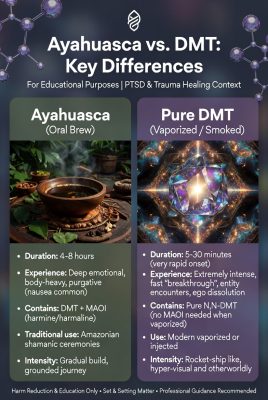
At a Glance: Ayahuasca vs DMT
| Feature | Ayahuasca | DMT (Smoked/Vaporized) |
|---|---|---|
| Onset of Effects | 20–60 minutes | 1–15 seconds |
| Peak Experience | 1.5–2 hours after ingestion | 5 minutes |
| Total Duration | 4–8 hours | 15–20 minutes (after-effects up to 1 hour) |
| Route of Administration | Oral (as a brewed tea) | Inhalation (smoking or vaping) |
| Key Component | DMT + MAOIs (harmala alkaloids) | Pure, isolated DMT |
| Primary Context | Traditional Amazonian ceremony | Modern, often solo use |
1. Onset and Duration: A Marathon vs A Sprint
The most dramatic difference between Ayahuasca vs DMT is the timeline of the experience.
🌿 Ayahuasca is a slow, immersive journey. After drinking the brew, it takes about 30 to 60 minutes for the first effects to appear–. The experience then gradually builds to a peak around 90 to 120 minutes, offering a long, introspective state that can last for 4 to 8 hours. This extended timeframe allows for deep psychological processing, often guided by a shaman or facilitator.
⚡ Smoked/Vaporized DMT is the opposite: incredibly fast and intense. When vaporized, users report feeling the first effects within seconds (1–15 seconds). The peak of the experience hits at around 5 minutes and the entire acute trip is typically over in 15 to 20 minutes. This rapid, “breakthrough” experience is often described as being launched into an alternate reality and then returned just as quickly.
Key Takeaway: Ayahuasca offers a prolonged, gradual state for therapeutic work, while smoked DMT provides an extremely brief but powerful “lightning bolt” experience.
2. Pharmacology: Why One Drink Works and the Other Doesn’t
This is the core scientific difference. Both substances contain DMT, but their chemical “packaging” is completely different.
DMT on its own is not active when swallowed. Your digestive system produces an enzyme called monoamine oxidase (MAO) that breaks down DMT before it can reach your brain, making it ineffective if simply eaten.
-
🌿 Ayahuasca solves this problem. The Amazonian vine Banisteriopsis caapi contains natural MAO inhibitors (MAOIs) called β-carbolines (e.g., harmine, harmaline). By brewing these MAOIs together with DMT-containing leaves (like Psychotria viridis), the MAOIs temporarily block the enzyme, allowing the DMT to survive digestion, enter the bloodstream, and become orally active. The MAOIs also have their own psychoactive effects, contributing to the overall character of the experience.
-
⚡ Pure, Smoked DMT bypasses the digestive system entirely. By vaporizing and inhaling the pure DMT molecule, it is absorbed directly into the bloodstream through the lungs and travels rapidly to the brain, completely avoiding the gut’s MAO enzymes.
Key Takeaway: The presence of MAOIs in ayahuasca is the chemical key that unlocks its long, oral journey. Smoked DMT uses a different route (inhalation) to achieve its rapid effect.
3. Traditional and Ceremonial Use: Ancient Wisdom vs Modern Exploration
The context in which these substances are used is another critical point of distinction.
-
🌿 Ayahuasca has a rich, unbroken history of ceremonial use by indigenous peoples of the Amazon Basin for healing, spiritual connection, and divination, a practice spanning centuries. Its name comes from the Quechua language, meaning “vine of the spirits” or “vine of the souls“–. Traditional ceremonies are highly structured, led by a trained shaman, and involve a strict ceremonial framework including singing icaros (healing songs), creating a safe and guided container for the experience.
-
⚡ Pure DMT (in its smoked or injected form) has no known history of traditional use for healing or spiritual purposes. There are no ancient shamanic rituals associated with smoking isolated DMT. Its use is a modern phenomenon, popularized in the 20th century following the isolation and synthesis of the compound in 1931.
Key Takeaway: Ayahuasca is inseparable from its cultural and ceremonial roots. The isolated DMT molecule is a modern tool often explored in a personal, non-traditional context.
4. Therapeutic Potential: Research for PTSD and Depression
Both Ayahuasca and DMT are being investigated for their potential to treat mental health conditions, including PTSD, depression, and anxiety–.
-
🌿 Ayahuasca has been the subject of observational studies and clinical trials showing promising results for treating depression, anxiety, PTSD, and substance use disorders. Human neuroimaging studies suggest it may decrease activity in the brain’s default mode network (DMN), leading to a more flexible and less rigid thinking pattern a key mechanism thought to underlie its therapeutic effects.
-
⚡ DMT is also being explored for its therapeutic potential, particularly for major depressive disorder and treatment-resistant depression. Research into DMT-assisted therapy for PTSD is still in its preliminary stages–. Its short duration is a unique advantage for clinical settings, potentially allowing for a full therapeutic session within a standard clinical hour.
Key Takeaway: Both substances show promise, but the research on ayahuasca is currently broader, while DMT’s potential lies partly in its short, manageable duration for clinical use.
5. Safety Profile and Side Effects
Both ayahuasca and DMT are considered to have an acceptable safety profile when used in controlled settings and have very low addiction potential. However, they come with different physical side effects.
-
🌿 Ayahuasca is famously known for causing vomiting and diarrhea, often referred to as “la purga” (the purge). In the traditional context, this is viewed as a physical and spiritual cleansing of negative energies or emotions. Ayahuasca also has more dietary contraindications due to the MAOIs, which can dangerously interact with certain medications (like SSRIs) and foods high in tyramine.
-
⚡ Smoked DMT generally does not cause vomiting. However, its intensity can be psychologically overwhelming, leading to anxiety, fear, or a sense of depersonalization during the experience–. The rapid and complete loss of control can be more disorienting than the gradual onset of ayahuasca.
Key Takeaway: Both require careful consideration, but their physical side effect profiles are distinct purging for ayahuasca versus potential acute psychological distress for smoked DMT.
6. Legal Status: A Complex Global Patchwork
The legal status of Ayahuasca and DMT is different and complex.
-
The Isolated Molecule DMT is almost universally prohibited. Under the 1971 UN Convention on Psychotropic Substances, DMT is a Schedule I controlled substance, meaning it is considered to have a high potential for abuse and no accepted medical use.
-
Ayahuasca occupies a legal gray area. While the International Narcotics Control Board (INCB) has stated that ayahuasca is not itself an internationally controlled substance, it contains DMT, which This leads to varying national interpretations:
-
In countries like France and Italy, the presence of DMT means ayahuasca is automatically considered illegal.
-
In Spain, courts often distinguish between pure DMT and ayahuasca as a traditional preparation, leading to case-by-case decisions.
-
Some countries, like Brazil and Peru, have legal frameworks protecting its religious use.
-
Key Takeaway: Pure DMT is illegal in most countries. The legality of ayahuasca is a complex, country-specific issue that depends on how local laws interpret its status as a traditional preparation containing a controlled substance.
Conclusion: Which One Is Right for You?
The choice between Ayahuasca vs DMT is not about which is “better,” but about which is more appropriate for a specific intention and context.
-
Choose Ayahuasca if you are seeking a long, deep, introspective journey, possibly in a ceremonial group setting with experienced facilitators, and have the time and intention for extended psychological and emotional processing.
-
Choose Smoked DMT if you are interested in a brief, extremely intense, self-contained experience and are prepared for a rapid and complete loss of ordinary reality, usually in a private setting.
At Psychapotheke, we are committed to providing science-based education on psychedelic substances. Neither ayahuasca nor pure DMT is legally available for purchase for personal use in most of the world. This guide is for educational purposes only, to help you understand the significant differences between these two powerful psychedelics within the context of ongoing research and traditional knowledge.
Disclaimer: This information is for educational purposes only and does not constitute medical or legal advice. Always consult a licensed healthcare provider and be aware of the laws in your jurisdiction. Ayahuasca vs DMT