

DMT Dosage: How Much Is Safe? A Science‑Based Guide
Searching for “DMT dosage: how much is safe?” is a common first step for those curious about the powerful psychedelic N,N‑dimethyltryptamine (DMT). Whether you are a researcher, a mental health advocate, or someone exploring the therapeutic potential of psychedelics for conditions like PTSD, understanding dose‑response relationships is essential.
At Psychapotheke, we provide evidence‑based, legal, and ethical education. This guide synthesizes clinical research, pharmacokinetic data, and harm‑reduction principles to answer the most critical question: what is a safe DMT dosage?
⚠️ Important: There is no “recreational” safe dose outside of controlled clinical settings. All dosage information below comes from peer‑reviewed studies and is provided solely for educational purposes.
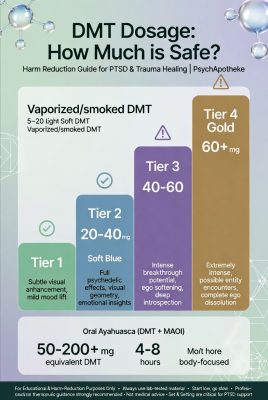
How DMT Works – Pharmacokinetics in Brief
DMT is rapidly metabolized by monoamine oxidase (MAO) in the gut and liver, which is why oral DMT alone is ineffective unless combined with an MAO inhibitor (as in ayahuasca).– When administered intravenously or by inhalation, DMT reaches peak plasma concentrations within minutes and clears rapidly, resulting in a short‑lasting but intensely powerful experience.
The relationship between DMT plasma concentration and subjective effects follows a sigmoidal (non‑linear) dose‑response curve. Small increases in dose can push a user from mild perceptual changes into a full “breakthrough” experience
DMT Dosage by Route of Administration
Below is a summary of typical DMT doses reported in clinical and observational studies. These are not recommendations , they are data points for educational reference.
| Route of Administration | Typical Dose Range | Onset | Duration | Key Observations |
|---|---|---|---|---|
| Vaporized / Smoked | 20–60 mg (breakthrough often at 25–50 mg) | Seconds | 5–20 min | Most common route; rapid onset, intense peak, quick return |
| Intravenous (IV) | 0.1–0.3 mg/kg (approx. 7–25 mg for 80 kg person) | 30–60 sec | 20–30 min | Used in clinical trials; precise dosing; rapid resolution of effects– |
| Intramuscular (IM) | 60–100 mg | 5–10 min | 30–60 min | Slower rise than IV; longer experience |
| Oral (with MAOI, e.g., ayahuasca) | 0.6–0.85 mg DMT / kg body weight + harmine | 30–60 min | 4–6 hours | MAOI inhibits gut MAO, allowing oral activity; duration much longer |
| Oral (without MAOI) | >350 mg | None | None | “Completely without effect either physiological or psychological” |
Key Insights from Clinical Research
-
Vaporized DMT (60 mg) in a randomized, double‑blind, placebo‑controlled trial was found to be “safe, well‑tolerated, and capable of inducing profound altered states of consciousness.” Adverse events were predominantly mild and transient. Physiological changes (blood pressure, heart rate) remained within safe limits.
-
Intravenous DMT at 0.1 and 0.3 mg/kg was mostly safe and tolerated in a small exploratory pilot study, showing potential next‑day antidepressant effects in patients with treatment‑resistant major depressive disorder.
-
The “breakthrough” threshold for vaporized DMT typically occurs between 25 mg and 60 mg, depending on individual sensitivity and vaporization efficiency. Some individuals may experience a breakthrough at as little as 25 mg, while others require 50–60 mg.
-
Low doses (below 20 mg vaporized) generally produce mild perceptual changes – enhanced colors, geometric patterns, and a sense of “synthetic” visual texture – without a full breakthrough.
Physiological Safety & Adverse Effects
What the Science Says
Multiple early‑phase clinical trials have consistently reported that DMT is generally well‑tolerated in controlled settings, with no serious adverse events in most studies.– A 2025 systematic review of DMT safety in healthy volunteers and MDD patients found:
-
Adverse events were mostly mild and self‑limited (e.g., transient nausea, dizziness).
-
No serious adverse events were reported across reviewed trials.
-
Psychotomimetic effects (ego dissolution, mystical experiences) were dose‑dependent but manageable.
Common Acute Effects
| Effect | Typical Characteristics |
|---|---|
| Cardiovascular | Transient increase in blood pressure (systolic up to +40 mmHg) and heart rate, resolving within 20–30 minutes |
| Psychological | Intense anxiety, fear, or dread (especially during rapid onset); depersonalization; time distortion– |
| Perceptual | Vivid hallucinations, geometric patterns, “breakthrough” to otherworldly environments |
| Somatic | Pupil dilation, sweating, numbness at injection/inhalation site |
⚠️ Cardiovascular warning: Intravenous or inhaled DMT causes abrupt increases in blood pressure and heart rate, which pose risks for individuals with hypertension, coronary artery disease, or other cardiovascular conditions.“
Contraindications
Based on clinical guidelines and harm‑reduction principles, DMT should be strictly avoided in individuals with:
-
Personal or family history of psychosis, schizophrenia, or bipolar disorder – psychedelics can worsen or trigger latent psychiatric conditions.–
-
Uncontrolled hypertension or significant cardiovascular disease – due to acute sympathomimetic effects.
-
Pregnancy or breastfeeding – no safety data available.
-
Concurrent use of MAOIs, SSRIs, or other serotonergic drugs – risk of serotonin syndrome or unpredictable interactions.–
Long‑Term Safety
Available evidence suggests that DMT has limited neurotoxicity and does not appear to cause organ damage or persistent cognitive impairment when used occasionally in controlled settings. However, frequent use may lead to psychological dependency in vulnerable individuals
DMT in Clinical Research for PTSD & Depression
While most DMT dosage research has focused on healthy volunteers and treatment‑resistant depression, interest in its application for PTSD is growing.
-
A 2025 review noted that classic psychedelics including DMT may improve symptoms of anxiety, depression, and promote fear extinction and neurogenesis – mechanisms relevant to PTSD treatment.
-
Ongoing trials are exploring DMT combined with psychotherapy for trauma‑related disorders, though specific PTSD dosage protocols are still in early phases.
-
The rapid onset and short duration of vaporized DMT make it particularly appealing for session‑based therapy, allowing clinicians to work within a predictable time window.
Psychapotheke does not condone or encourage any illegal activity. This information is provided solely for legal and educational awareness.
Harm Reduction, If You Choose to Explore
We strongly advise against any non‑medical, non‑clinical use of DMT. However, harm‑reduction principles can reduce risks for those who ignore this warning.
Basic Safety Measures
-
Never use alone. Have a sober, trusted sitter present.
-
Start low, go slow. Begin with a threshold dose (e.g., 5–10 mg vaporized) to assess individual sensitivity.
-
Test your substance. Use reagent kits to rule out adulterants or synthetic substitutes.
-
Avoid combinations. Do not mix DMT with alcohol, cannabis, SSRIs, MAOIs, or other stimulants.
-
Screen contraindications. If you have personal or family history of psychosis, bipolar disorder, or heart problems , do not use DMT.
-
Prepare your set and setting. A calm, safe, comfortable environment reduces the risk of a “bad trip.”
What to Do in a Crisis
-
If someone experiences severe agitation, psychosis, or medical distress, seek emergency medical help immediately.
-
Be honest with medical professionals about what was taken , they are there to help, not to judge.
-
For psychological distress (e.g., panic, fear), gentle reassurance, a quiet environment, and grounding techniques (focusing on breathing or a familiar object) can be helpful.
Frequently Asked Questions (FAQ)
There is no universally “safe” dose outside of a clinical trial. In research settings, vaporized doses up to 60 mg and IV doses up to 0.3 mg/kg have been well‑tolerated by healthy volunteers with medical supervision. Any unsupervised use carries unpredictable risks.
No fatal overdose from DMT alone has been documented in the medical literature. However, excessive doses can cause terrifying psychological reactions, dangerous behavior, and cardiovascular strain. Combination with other substances (e.g., MAOIs, alcohol) increases the risk of serious harm.
While preliminary research suggests potential benefits, DMT is not an approved treatment for PTSD. The only legal and safe way to explore DMT for PTSD is through participation in an approved clinical trial
Vaporized / smoked: 5–20 minutes (peak at 2–5 minutes)
Intravenous: 20–30 minutes
Intramuscular: 30–60 minutes
Oral with MAOI (ayahuasca): 4–6 hours
DMT is rapidly broken down by monoamine oxidase (MAO) in the gut and liver. When taken orally without an MAO inhibitor, it is destroyed before reaching the bloodstream, producing no psychoactive effects.
Some individuals report microdosing DMT (1–5 mg vaporized). However, there is no clinical research supporting the safety or efficacy of DMT microdosing. Microdosing may still carry cardiovascular and psychological risks.
DMT does not produce classic signs of physical dependence or withdrawal. However, psychological dependency can develop, especially in individuals with a history of substance use disorders. Tolerance builds rapidly with repeated use (within hours), limiting compulsive redosing.
Conclusion: Knowledge is the First Step to Safety
Understanding DMT dosage is not about finding a “safe” way to use an illegal substance. It is about education, harm reduction, and informed decision‑making.
At Psychapotheke, we believe that accurate, science‑based information is a public health necessity. Whether you are a researcher, a clinician, or an individual seeking healing, we are here to provide legal, ethical, and evidence‑based resources.
-
✅ Learn – Explore our clinical trial database and educational library.
-
✅ Stay legal – Participate in approved research or legal alternatives like ketamine‑assisted therapy.
-
✅ Stay safe – If you choose to explore, follow harm‑reduction principles.
Your health and safety come first. Always.
Sources & Further Reading
-
Strassman, R. J., et al. (1994). Dose‑response study of N,N‑dimethyltryptamine in humans. Archives of General Psychiatry.
-
Clinical trial: Vaporized DMT (60 mg) Safety, tolerability and subjective effects (2025). ScienceDirect.
-
Exploratory study: IV DMT (0.1 & 0.3 mg/kg) in MDD (2022). Nature.
-
Population PK/PD modeling of DMT + harmine (2025). ScienceDirect.
-
Cardiovascular risk mitigation with beta‑blockers (2025). ACS Medicinal Chemistry Letters.
-
German legal status: BtMG Annex I. ICEERS.
Medical & Legal Disclaimer
This article is for educational purposes only and does not constitute medical advice. DMT is a Schedule I / Annex I controlled substance in most countries. Psychapotheke does not encourage or condone illegal activity. Always consult a licensed healthcare provider before considering any substance use. Laws vary by jurisdiction and may change over time. Verify your local regulations.
Psychapotheke – Science. Safety. Psychedelic Education.