LSD Therapy: Research & Benefits | Psychapotheke
Introduction: The Renaissance of LSD Therapy
Lysergic acid diethylamide (LSD) is undergoing a remarkable scientific renaissance. Once dismissed as a countercultural relic, this powerful psychedelic compound is now being rigorously investigated for its therapeutic potential in treating some of the most challenging mental health conditions, including post-traumatic stress disorder (PTSD), generalized anxiety disorder (GAD), and treatment-resistant depression.LSD Therapy: Research & Benefits
At Psychapotheke, we provide evidence-based education on psychedelic-assisted therapy (PAT). This comprehensive guide explores the current state of LSD therapy research, its neurobiological mechanisms, clinical benefits, and what the future holds for this promising treatment modality.
Part 1: Informational — What Is LSD Therapy?
LSD therapy refers to the supervised, controlled administration of lysergic acid diethylamide as part of a structured therapeutic framework. Unlike recreational use, therapeutic LSD administration occurs in a clinical setting with medical monitoring and, in many protocols, psychological support.
A Brief History
Modern psychedelic research began in 1938 when Swiss chemist Albert Hofmann first synthesized LSD at Sandoz Laboratories . During the 1950s and 1960s, researchers explored LSD for treating:
-
Alcohol and substance use disorders
-
Cancer-related anxiety and end-of-life distress
-
Refractory depression
-
Obsessive-compulsive disorder
However, the 1970 Controlled Substances Act classified LSD as a Schedule I substance defined as having “no accepted medical use” effectively halting legitimate research for decades . Today, we are witnessing a renaissance as regulatory barriers slowly ease and clinical trials resume.LSD Therapy: Research & Benefits
Part 2: Educational — How LSD Works in the Brain
Primary Mechanism: Serotonin 2A Receptor Activation
LSD exerts its primary effects by binding to and activating the serotonin 2A receptor (5-HT2A), which is highly expressed in brain regions controlling mood, emotion, and cognition. This activation triggers a cascade of neurobiological changes:
Neuroplasticity: Rewiring the Brain
One of the most exciting discoveries is LSD’s ability to promote neuroplasticity the brain’s capacity to form new neural connections. Research demonstrates that even low doses of LSD can drastically increase brain plasticity, potentially allowing the brain to “reset” maladaptive circuits responsible for depression and anxiety.
“Psychedelics offer potential in counteracting the damaging effects from prolonged exposure to stress… fostering neuroplasticity that may allow recovery of brain regions impacted by cortisol.”
Fear Extinction and Amygdala Modulation
For PTSD patients, LSD shows particular promise by suppressing learned fear responses. Research from the Medical College of Wisconsin suggests that psychedelics reduce fear-related activity in the amygdala by enhancing inhibitory signaling from GABAergic interneurons .
This mechanism may help patients process traumatic memories without being overwhelmed by fear responses a critical component of PTSD recovery.
Beyond Serotonin: Multiple Pathways
LSD’s therapeutic effects extend beyond serotonin receptors. The compound also interacts with dopamine and adrenergic receptors, contributing to its complex pharmacological profile and potentially enhancing its mood-elevating properties.
Part 3: Clinical Research & Benefits
LSD for Generalized Anxiety Disorder
Landmark 2025 Study Results
A groundbreaking Phase II clinical trial published in the Journal of the American Medical Association (JAMA) has demonstrated remarkable results for LSD in treating generalized anxiety disorder.
Study Design:
-
198 adults with moderate-to-severe GAD
-
Randomized to receive single doses of 25, 50, 100, or 200 micrograms of MM120 (pharmaceutical LSD) or placebo
-
12-week follow-up period
Key Findings
| Dosage | Outcome |
|---|---|
| 100 mcg | Most effective; rapid, significant, durable relief |
| 200 mcg | No better than 100 mcg; increased side effects |
| 25-50 mcg | No significant effect vs. placebo |
Clinical Outcomes:
-
65% of patients receiving 100 mcg showed sustained improvement at 12 weeks
-
47.5% achieved remission meaning their anxiety symptoms all but disappeared
-
Effects began within days of a single dose
“The study suggests that for people who have suffered for years with a chronic condition… in a single dose, may actually lead to a remission of symptoms in the majority of patients.” Dr. Maurizio Fava, Mass General Brigham
LSD for PTSD
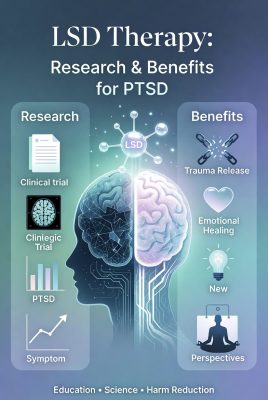
While MDMA currently has the most developed evidence base for PTSD, LSD is emerging as a promising candidate . Research indicates that psychedelics may help by:
-
Suppressing learned fear responses through amygdala modulation
-
Promoting fear extinction—allowing patients to unlearn traumatic associations
-
Increasing psychological flexibility enabling patients to process trauma without avoidance
A comprehensive systematic review published in Current Neuropharmacology notes that while LSD data for PTSD remains preliminary, it shows “suggested potential benefits” that warrant further investigation.
LSD for Treatment-Resistant Depression
Treatment-resistant depression (TRD) affects approximately 30% of MDD sufferers individuals who do not respond to conventional antidepressants . LSD offers a novel approach:LSD Therapy: Research & Benefits
Key Advantages Over Traditional Antidepressants:
-
Rapid onset (days vs. weeks for SSRIs)
-
Single-dose potential (vs. daily medication)
-
Durable effects (months vs. continuous dosing)
-
Unique mechanism (neuroplasticity vs. monoamine reuptake inhibition)
Research published in Neuroscience & Biobehavioral Reviews highlights that LSD may induce “rapid and long-term antidepressant responses, possibly by the facilitation of neuroplasticity and adjustment of long-term neural communication, even after the drug is cleared from the body”.
Part 4: Safety & Tolerability
Common Adverse Effects
Clinical trials consistently report that LSD is generally well-tolerated when administered in controlled settings. The most common side effects include
-
Hallucinations (nearly 93% at 100 mcg dose)
-
Nausea (approximately 40% at 100 mcg dose)
-
Headaches
-
Transient blood pressure increases
-
Fatigue
-
Anxiety during the experience
Unique Safety Consideration
Unlike daily medications, LSD’s side effects are largely confined to the day of administration. As Dr. Fava notes:
“The side effects… are there on the day of administration… But it’s different from the traditional approach in that all the other treatments require daily administration, and so the side effects persist over time.”
Risk Factors and Contraindications
LSD therapy is not appropriate for everyone. Contraindications include:
-
Personal or family history of psychosis or schizophrenia
-
Bipolar I disorder
-
Certain cardiovascular conditions
-
Concurrent use of serotonergic medications (risk of serotonin syndrome)
No Psychotherapy Required?
A surprising finding from the 2025 anxiety trial was that patients received no psychotherapy during their dosing session only safety monitoring . This challenges the assumption that psychedelic-assisted therapy requires extensive concomitant talk therapy.
“What was unique about this study was that they were administering the psychedelic without concomitant psychotherapy… There’s an open question as to whether the psychotherapy is really necessary.” Nehal Vadhan, Northwell Health
However, researchers emphasize that integration support following the experience remains valuable.
Part 5: Current Limitations & Research Challenges
The Blinding Problem
One significant challenge in psychedelic research is the difficulty of maintaining effective blinding. Most participants correctly guess whether they received LSD or placebo due to the drug’s distinctive effects. This introduces potential bias and complicates interpretation of subjective outcome measures.
FDA Approval Hurdles
Despite promising results, FDA approval is not guaranteed. The agency previously rejected MDMA-assisted therapy for PTSD despite positive Phase III trials, citing concerns about functional unblinding and trial design.
Need for Larger Trials
Current evidence, while encouraging, comes from relatively small sample sizes. Phase III trials are now underway to address:
-
Long-term durability of effects
-
Optimal re-treatment intervals
-
Safety in larger, more diverse populations
-
Comparison with existing standard-of-care treatments
Part 6: The Future of LSD Therapy
Ongoing and Upcoming Research
MindMed, the company developing MM120, is conducting two larger late-stage trials tracking patients over longer periods. The FDA has granted “breakthrough therapy” status to LSD for generalized anxiety disorder, expediting the development and review process.
Potential Applications Beyond Psychiatry
Emerging research suggests LSD may have applications for:
-
Cluster headaches (anecdotally effective at sub-perceptual doses)
-
End-of-life anxiety (building on 1960s research)
-
Substance use disorders (continuing the work of the 1950s-60s)
Integration into Clinical Practice
If approved, LSD therapy would represent a paradigm shift in psychiatric treatment moving from daily pills to periodic, supervised dosing sessions. This model could reduce the burden of daily medication adherence and side effects while providing durable symptom relief.
Conclusion: A Promising but Investigational Treatment
LSD therapy represents one of the most exciting frontiers in mental health treatment. Current evidence supports its potential for:
✅ Rapid, durable relief from generalized anxiety
✅ Neuroplasticity promotion that may “reset” maladaptive brain circuits
✅ Fear extinction mechanisms relevant to PTSD
✅ A novel approach for treatment-resistant depression
However, important caveats remain:
⚠️ LSD remains an investigational compound not an approved treatment
⚠️ Current access is limited to clinical trials
⚠️ Further research is needed on long-term safety and optimal protocols
⚠️ FDA approval faces significant regulatory hurdles
At Psychapotheke, we remain committed to providing accurate, evidence-based information on psychedelic-assisted therapy. As research progresses, we will update this guide with the latest findings. LSD Therapy: Research & Benefits
Frequently Asked Questions (FAQ)
LSD remains a Schedule I controlled substance in most countries. Therapeutic use is currently only available through approved clinical trials.
Both are serotonergic psychedelics, but LSD has a longer duration of action (8-12 hours vs. 4-6 hours for psilocybin) and a broader receptor binding profile, including dopamine and adrenergic receptors
Yes. The 2025 JAMA study demonstrated that a single 100 mcg dose of LSD provided symptom relief lasting at least 12 weeks in a majority of participants
In controlled clinical settings with appropriate screening and monitoring, LSD has demonstrated an acceptable safety profile. Common side effects are transient and resolve within the dosing day.
Check clinical trial registries (clinicaltrials.gov) for ongoing studies. Eligibility criteria vary by trial. Psychapotheke does not directly enroll participants but provides educational resources to help you navigate options.
Current evidence suggests LSD can significantly reduce symptoms, often to the point of remission. However, “cure” is too strong a word. More research is needed on long-term outcomes and the potential need for re-treatment.
References
-
Robison, R., et al. (2025). Single-dose LSD (MM120) for generalized anxiety disorder: A phase 2 randomized clinical trial. Journal of the American Medical Association.
-
Kelly, T.J., & Liu, Q.S. (2024). Exploring the therapeutic potential of psychedelics: Fear extinction mechanisms and amygdala modulation. Psychedelics, Genomic Press.
-
Fava, M., et al. (2025). LSD for generalized anxiety disorder: Phase II trial results. JAMA.
-
Jin, S., et al. (2025). Psychedelics in the context of stress and psychiatric disorders: A new horizon in mental health treatment. Psychedelics.
-
Vadhan, N., et al. (2025). Commentary on LSD for anxiety. Northwell Health.
-
Systematic review on psychedelics for PTSD. (2026). Current Treatment Options in Psychiatry, Springer.
-
Zaretsky, T.G., et al. (2024). The psychedelic future of post-traumatic stress disorder treatment. Current Neuropharmacology.
-
Fava, M. (2025). LSD may ease anxiety symptoms for months, study finds. Associated Press / Drugs.com.
-
Kosobuski, L. Psychedelic medications: Renaissance, revelations, and rediscoveries in mental health. University of Minnesota College of Pharmacy.
Medical Disclaimer: This content is for educational purposes only and does not constitute medical advice. LSD is an investigational compound not approved for general medical use. Always consult a licensed healthcare provider before making any decisions about mental health treatment.
Legal Disclaimer: Laws regarding LSD vary by country. Psychapotheke does not encourage or condone illegal activities. This information is provided solely for educational and harm-reduction purposes.