
How Long Does an LSD Trip Last? Complete Timeline & Safety Guide
Fact-checked by clinical research sources
If you are researching LSD (lysergic acid diethylamide) whether for psychedelic-assisted therapy (PAT), personal education, or harm reduction one of the most common questions is: ” How long does an LSD trip last? “. The short answer: 8 to 12 hours on average, depending on dosage, individual physiology, and environmental factors.
This comprehensive guide provides accurate, science-based information on LSD duration, trip phases, influencing factors, and critical safety considerations.
⚠️ Legal & safety notice: LSD is a controlled substance in Germany (BtMG Schedule I), the US (Schedule I), and most countries. This content is for educational and harm-reduction purposes only. Psychapotheke does not promote illegal substances.
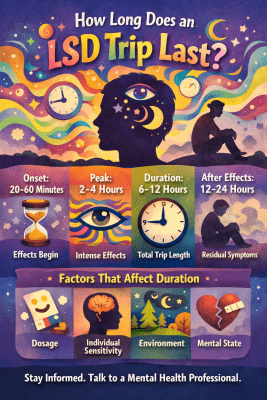
Part 1: Quick Answer on LSD Trip Duration at a Glance
| Phase | Typical Duration | Description |
|---|---|---|
| Onset (come-up) | 20–60 minutes | First subtle effects appear |
| Peak | 2–5 hours | Maximum intensity of effects |
| Plateau | 3–6 hours | Sustained high, stable effects |
| Comedown (offset) | 2–4 hours | Gradual decline in intensity |
| Afterglow | 6–24 hours post-trip | Residual mood changes, insight, fatigue |
Total active trip time: 8–12 hours
Full return to baseline (including afterglow): 12–24 hours
Part 2: Detailed LSD Trip Timeline
Phase 1: Onset (20–60 minutes after ingestion)
What happens:
-
First signs: subtle changes in mood, perception, or body awareness
-
Colors may appear slightly brighter
-
Mild anxiety or excitement (common)
What to expect:
“You may feel ‘something is different’ but not yet fully altered.”
Duration factors:
Empty stomach = faster onset (~20–30 min)
Full stomach = slower onset (~45–60 min)
Phase 2: Peak (2–5 hours after ingestion)
What happens:
-
Maximum psychedelic effects
-
Visual distortions (patterns, tracers, morphing surfaces)
-
Altered sense of time (minutes can feel like hours)
-
Ego dissolution at higher doses
-
Intense emotions (joy, awe, fear, or all three)
What to expect:
“This is the most intense phase. External environment and mindset strongly influence experience.”
Critical note:
Never drive, operate machinery, or make important decisions during peak.
Phase 3: Plateau (3–6 hours after ingestion)
What happens:
-
Effects remain strong but stable (no longer intensifying)
-
Peak intensity sustained for several hours
-
Cognitive shifts, philosophical or spiritual thoughts common
-
Physical coordination still impaired
What to expect:
“The plateau can feel timeless. Many users report profound insights here.”
Phase 4: Comedown (2–4 hours, starting around hour 6–8)
What happens:
-
Visual effects gradually fade
-
Return to more normal thinking
-
Fatigue may set in
-
Emotional sensitivity remains high
What to expect:
“You are still under influence. Do not drive until fully sober (12+ hours after ingestion).”
Phase 5: Afterglow (6–24 hours post-ingestion)
What happens:
-
No active psychedelic effects
-
Enhanced mood, creativity, or introspection
-
Some report fatigue or brain fog
-
Insight integration period
What to expect:
“The afterglow is not a ‘trip’ but a residual state. Many consider it valuable for therapy or reflection.”
Part 3: Factors That Influence LSD Trip Duration
Not all LSD trips last the same length. Key variables include:
| Factor | Effect on Duration |
|---|---|
| Dosage | Higher doses (200µg+) may extend peak and total duration (up to 14 hours) |
| Individual metabolism | Faster metabolism = shorter duration (rare) |
| Food intake | Full stomach delays onset but may slightly extend total duration |
| Tolerance | Repeated use within 3–4 days drastically reduces effects (not duration) |
| Set & setting | Does not change duration but changes subjective experience of time |
| Other substances | Cannabis can intensify and prolong effects; benzodiazepines shorten/abort trips |
Typical Dosage & Duration Correlation
| Dosage | Typical Duration | Peak Intensity |
|---|---|---|
| Microdose (5–20µg) | 4–6 hours | Sub-perceptual |
| Low dose (25–75µg) | 6–8 hours | Mild |
| Standard dose (75–150µg) | 8–12 hours | Moderate to strong |
| High dose (150–300µg) | 10–14 hours | Very strong |
| Very high dose (300µg+) | 12+ hours | Extreme (not recommended) |
Part 4: LSD in Psychedelic-Assisted Therapy (PAT)
In clinical research for conditions like PTSD, depression, and anxiety:
-
Therapeutic LSD sessions are supervised by medical professionals
-
Sessions last 8–10 hours in a controlled environment
-
Patients remain at the clinic until fully sober
-
Integration therapy occurs days or weeks later
📖 Related: Psychedelic-Assisted Therapy for PTSD Research Update
Key difference from recreational use:
Clinical LSD administration uses pure, precisely dosed pharmaceutical-grade LSD in safe, supportive settings never alone or unmonitored.
Part 5: Critical Safety Information
❌ Do NOT operate vehicles or machinery
LSD impairs coordination, judgment, and reaction time for 12+ hours. Driving under influence is illegal and deadly.
❌ Do NOT take LSD if:
-
Personal or family history of psychosis or schizophrenia
-
Currently on lithium, SSRIs, or MAOIs (dangerous interactions)
-
Pregnant or breastfeeding
-
Alone without a trusted sober sitter
✅ Harm reduction (if use occurs):
-
Test your substance (reagent kits detect some adulterants)
-
Start low, go slow you can always take more, never less
-
Have a sober trip sitter ideally someone experienced
-
Choose a safe, familiar environment
-
Avoid mixing with alcohol, cannabis, or other drugs
⚠️ Legal reminder: Possessing or obtaining LSD outside approved clinical research is illegal in Germany, the US, and most countries.
Part 6: How Long Does LSD Stay in Your System? (Detection Windows)
Many people confuse trip duration with detection time.
| Test Type | Detection Window |
|---|---|
| Blood | 0–12 hours |
| Urine | 1–4 days (occasionally up to 5 days) |
| Hair | Up to 90 days |
Important: You can be completely sober (no trip effects) but still test positive for days afterward.
Part 7: Common Myths About LSD Duration Busted
Myth 1: “LSD trips last 24+ hours”
False. True active effects rarely exceed 14 hours, even at very high doses. Perceived time distortion can make it feel longer, but actual duration is 8–12 hours on average.
Myth 2: “Flashbacks last as long as a trip”
False. Hallucinogen Persisting Perception Disorder (HPPD) rare “flashbacks” last seconds or minutes, not hours.
Myth 3: “You can sleep off an LSD trip”
False. LSD is a stimulant-like psychedelic. Most people cannot sleep until 12+ hours after ingestion, even if they want to.
Myth 4: “Food or vitamin C stops a trip”
False. Once LSD is absorbed, nothing short of benzodiazepines or antipsychotics (in clinical settings) significantly shortens duration.
Frequently Asked Questions (FAQ)
Extremely unlikely. At standard doses, no. At extremely high doses (500µg+), some residual effects may linger up to 14–16 hours, but full 24-hour active trips are virtually unheard of with pure LSD.
Possible reasons:
Low dosage (under 50µg)
You took something else (e.g., research chemical, not LSD)
Rapid individual metabolism (rare)
Tolerance from recent use
Possible reasons:
-
High dosage (200µg+)
-
Redosing (taking more mid-trip)
-
Interaction with cannabis or other substances
-
Individual sensitivity
No. The molecule works the same way. However, clinical settings provide preparation, monitoring, and integration — which improves outcomes but does not change duration.
In a clinical setting: Yes — benzodiazepines (e.g., lorazepam) or antipsychotics can reduce anxiety and intensity.
At home: Not reliably. Hydration, changing environment, or calming music may help psychologically but not pharmacologically
Minimum 12 hours after ingestion. Better: 18–24 hours and only when you feel fully normal. LSD impairs judgment even after visual effects fade.
Final Word from Psychapotheke
Understanding how long an LSD trip lasts is essential for:
-
Harm reduction — planning a safe, supervised experience
-
Clinical research — designing effective PAT protocols
-
Education — replacing myths with science
At Psychapotheke, we provide evidence-based, legal, and safety-focused education on psychedelic substances and their therapeutic potential.
If you are interested in legal psychedelic-assisted therapy for PTSD, depression, or anxiety, we encourage you to:
-
Explore clinical trial databases
-
Consult with licensed mental health professionals
-
Learn about legal alternatives (ketamine therapy, breathwork, integration coaching)
Stay informed. Stay safe. Stay legal.
Medical & Legal Disclaimer
This content is for educational purposes only and does not constitute medical advice, an endorsement of illegal activity, or a recommendation to use LSD. Always consult a licensed healthcare provider for mental health treatment. LSD is a controlled substance in Germany (BtMG), the United States (Schedule I), and most other countries. Psychapotheke does not promote illegal substances.