

LSD Effects: Complete Guide to Psychological & Physical Effects
Introduction: Understanding LSD Effects
Lysergic acid diethylamide (LSD) is one of the most potent psychoactive substances known to science. First synthesized in 1938 by Swiss chemist Albert Hofmann, LSD has been the subject of extensive research into its effects on the human mind and body .
This comprehensive guide examines the full spectrum of LSD effects from psychological and physical changes to dosage-dependent variations, potential risks, and emerging therapeutic applications. All information is based on peer-reviewed research and clinical studies.
Medical Disclaimer: This content is for educational purposes only. LSD is a controlled substance in most countries. This information does not constitute medical advice or encouragement of illegal activity.
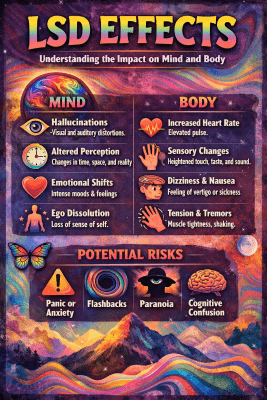
Part 1: How LSD Works in the Brain
Mechanism of Action
LSD primarily exerts its effects by binding to serotonin receptors in the brain, specifically the 5-HT2A receptor. These receptors are highly expressed in brain regions controlling mood, emotion, and cognition.
Key mechanisms include:
-
Serotonin 2A receptor agonism – The primary pathway for psychedelic effects
-
Dopamine system modulation – At higher doses, LSD stimulates dopamine D2 receptors
-
Glutamate system involvement – Contributes to altered perception and cognition
-
TAAR1 receptor binding – A trace amine-associated receptor that may influence mood
This receptor activation promotes neuroplasticity and changes in functional brain connectivity, which researchers believe underlies both the acute psychedelic experience and potential therapeutic benefits .
Part 2: Timeline of LSD Effects
Understanding when effects begin and how long they last is crucial for both clinical and harm-reduction contexts.
Onset and Duration
| Parameter | Time Frame |
|---|---|
| Onset of effects | 30–60 minutes after oral ingestion |
| Peak effects | 2–4 hours after ingestion |
| Total duration | 6–12 hours |
Clinical Dosage Data
Research has quantified the time course of LSD effects at different dosages :
| Dose | Time to Onset | Time to Offset | Effect Duration |
|---|---|---|---|
| 20 µg | 0.85 hours (approx. 51 min) | 5.2 hours | 4.3 hours |
| 10 µg | 1.1 hours (approx. 66 min) | 5.1 hours | 4.0 hours |
| 5 µg | 0.71 hours (approx. 43 min) | 5.4 hours | 4.7 hours |
Note: These measurements represent effects on the “under the influence” visual analog scale. Individual experiences vary significantly based on dose, set, and setting.
Part 3: Psychological Effects of LSD
Acute Psychological Effects
LSD produces a wide range of psychological changes that vary by dose, individual psychology, and environmental context.
1. Altered Perception
-
Visual distortions – Patterns, trails, geometric shapes, enhanced colors
-
Synesthesia – “Seeing” sounds or “hearing” colors (rare, dose-dependent)
-
Time distortion – Time appearing to slow down, speed up, or lose meaning
-
Changed body perception – Feeling of floating, merging with surroundings
2. Emotional Changes
-
Enhanced emotional empathy – Research shows psychedelics tend to enhance emotional empathy, though cognitive empathy remains unaffected
-
Emotional breakthrough – Intense emotional experiences, both positive and challenging
-
Mood lability – Rapid shifts between emotions
3. Cognitive Effects
Research on cognitive effects shows mixed results depending on task and timing :
| Cognitive Domain | Effect |
|---|---|
| Emotional empathy | Enhanced |
| Cognitive empathy | No significant effect |
| Memory | Impaired, enhanced, or no effect (task-dependent) |
| Reaction time | Dose-dependent impairment |
| Attention | Dose-dependent impairment |
| Inhibition | Dose-dependent impairment |
| Recognition of negative stimuli | Impaired during acute effects |
| Cognitive flexibility | Mixed findings |
4. Mystical-Type Experiences
At moderate to high doses (e.g., 150 µg and above), LSD can produce experiences characterized by :
-
Sense of unity or interconnectedness
-
Transcendence of time and space
-
Ineffability (difficulty describing the experience)
-
Positive mood and sense of sacredness
-
Noetic quality (feeling of encountering ultimate reality)
Post-Acute Psychological Effects
Some psychological changes may persist beyond the acute intoxication period:
-
Improved mood – Some studies report sustained improvements in depression and anxiety symptoms following LSD administration
-
Increased openness – Some research suggests lasting increases in the personality trait of openness
-
Psychological distress – In rare cases, anxiety or mood disturbances may persist
Part 4: Physical Effects of LSD
Common Physical Effects
Physical effects of LSD are generally mild and transient, though they can be distressing to some users :
| Physical Effect | Description |
|---|---|
| Dilated pupils (mydriasis) | Very common; lasts throughout the experience |
| Increased heart rate | Dose-dependent; typically mild to moderate |
| Elevated blood pressure | Transient increases, usually within normal ranges |
| Mild hyperthermia | Slight increase in body temperature |
| Sweating or chills | Temperature dysregulation |
| Tremor | Fine motor tremors, especially at higher doses |
| Nausea | More common with some psychedelics; less common with pure LSD |
| Insomnia | Difficulty sleeping due to prolonged duration |
| Appetite suppression | Reduced hunger during the experience |
Physiological Monitoring in Clinical Settings
Clinical trials monitor several autonomic effects :
-
Blood pressure (systolic and diastolic) – assessed repeatedly during sessions
-
Heart rate – monitored for tachycardia
-
ECG (QT-time) – to rule out cardiac conduction abnormalities
-
Prolactin and cortisol levels – measured as biomarkers of stress response
-
Oxytocin levels – measured to assess prosocial effects
Part 5: Dose-Dependent Effects
LSD is extremely potent, with effects varying dramatically by dose.
Dosage Ranges and Effects
| Dose | Effects |
|---|---|
| 20–50 µg | Threshold effects: mild perceptual changes, enhanced mood, slight energy shifts |
| 50–100 µg | Standard “light” trip: visual distortions, time perception changes, emotional openness |
| 100–200 µg | Full psychedelic experience: strong visual and auditory effects, ego dissolution possible, mystical experiences |
| 200–400 µg | Intense experience: profound alterations of consciousness, possible loss of reality testing |
| 400+ µg | Extremely intense: potential for complete ego dissolution, may be overwhelming even for experienced users |
Sub-Perceptual Effects
Even at very low doses (5–20 µg), measurable effects occur :
-
5 µg – Minimal to no subjective effects; measurable on visual analog scales in some individuals
-
10 µg – Some individuals report subtle mood or energy changes
-
20 µg – Threshold for noticeable psychoactive effects in most individuals
Part 6: Adverse Effects and Risks
While LSD is physiologically non-toxic compared to many recreational drugs, adverse psychological reactions can occur .
Acute Adverse Psychological Reactions
| Reaction | Description | Frequency |
|---|---|---|
| Anxiety or panic | Most common adverse effect; usually resolves with reassurance | Common |
| Confusion and agitation | More likely at higher doses or in unfamiliar settings | Less common |
| Paranoia | Fear of harm or persecution during the experience | Uncommon |
| Transient psychosis | Temporary loss of reality testing lasting hours to days | Rare |
Risk Factors for Adverse Reactions
Research has identified several factors that increase risk of adverse psychological reactions :
-
Pre-existing psychiatric conditions (especially psychotic disorders)
-
Family history of schizophrenia or bipolar disorder
-
Unsupervised or unsafe settings
-
High doses
-
Polydrug use
-
Poor psychological preparation
Serious but Rare Complications
Severe adverse effects are uncommon but have been documented :
-
Prolonged psychotic reactions – Lasting >48 hours; rate of approximately 1.8 per 1,000 patients in clinical studies
-
Hallucinogen Persisting Perception Disorder (HPPD) – Persistent visual disturbances lasting weeks to years
-
Suicidal behavior – Related to underlying psychiatric conditions or accidental injury during intoxication
-
Seizures – Rare; more likely with polydrug use or underlying seizure disorder
-
Hyperthermia – Rare; may occur with high doses in hot environments
Emergency Medical Treatment Risk
According to population studies, approximately 1% of LSD users sought emergency medical treatment within a year, with a per-event risk of 0.2%. The most common reason for hospital visits is psychological distress, including anxiety and panic.
Comparison: LSD vs. Other Substances
Unlike opioids or alcohol, LSD does not cause respiratory depression, making fatal overdose from the substance alone extremely rare . Most LSD-related fatalities are due to accidents (falls, drowning) or unsafe behavior during intoxication, not direct toxicity.
Part 7: Therapeutic Potential
Despite its classification as a controlled substance, LSD is being investigated for several therapeutic applications.
Mental Health Conditions Under Study
| Condition | Evidence Level | Key Findings |
|---|---|---|
| Anxiety (life-threatening disease) | Moderate positive | Gasser et al. (2014) found LSD effective for anxiety in cancer patients |
| Depression | Mixed | Overall meta-analyses show LSD did not have significant effect on depression across all studies, though some individual studies showed promise |
| Alcohol use disorder | Historical evidence | 1950s-60s studies suggested potential; modern research needed |
| PTSD | Emerging | Mechanism research ongoing; not yet established |
Proposed Therapeutic Mechanisms
LSD’s therapeutic potential is thought to derive from :
-
Neuroplasticity promotion – Enhancing the brain’s ability to form new connections
-
Emotional breakthrough – Allowing patients to access and process difficult emotions
-
Cognitive flexibility – Enabling new perspectives on long-standing problems
-
Anti-inflammatory effects – Preliminary evidence suggests decreased pro-inflammatory cytokines
Part 8: Long-Term Effects
Addiction and Dependence Potential
LSD does not produce compulsive drug-seeking behavior typical of addictive substances. No evidence of physical dependence or withdrawal symptoms has been reported in controlled studies.
Cognitive Long-Term Effects
Research on long-term cognitive effects is limited, but current evidence does not suggest persistent cognitive impairment in typical users. Some studies even suggest potential cognitive benefits in specific domains, though more research is needed.
HPPD (Hallucinogen Persisting Perception Disorder)
A small subset of users experience persistent visual disturbances after LSD use, including :
-
Visual snow or static
-
Halos around objects
-
Trailing images (palinopsia)
-
Flashes of color
These symptoms can last for weeks, months, or rarely years. EEG studies in HPPD patients suggest reduced cortical coherence, indicating cortical dysregulation. Some patients have found relief with medications like clonidine .
Part 9: Set, Setting, and Harm Reduction
The effects of LSD are profoundly influenced by set (mindset) and setting (environment) .
Set (Internal Factors)
-
Expectations – Positive expectations generally lead to better outcomes
-
Mood – Starting in a calm, stable mood reduces risk of difficult experiences
-
Preparation – Understanding what to expect reduces anxiety
-
Intentions – Clear therapeutic or exploratory intentions vs. casual use
Setting (Environmental Factors)
-
Physical safety – Safe, familiar environment without hazards
-
Social support – Presence of trusted, sober individuals (“trip sitters”)
-
Comfort – Access to water, comfortable temperature, soft lighting
-
Privacy – Freedom from interruptions or unwanted visitors
Harm Reduction Guidelines
For those who choose to use LSD despite legal restrictions, harm reduction practices include :
-
Test your substance – Use reagent kits to confirm identity and rule out adulterants (NBOMe compounds are more dangerous)
-
Start low, go slow – Begin with a low dose (50–100 µg)
-
Never use alone – Have a sober, trusted companion present
-
Avoid mixing – Combining with other serotonergic substances increases risk of serotonin syndrome
-
Do not drive – Effects last 12+ hours; plan accordingly
-
Avoid if at risk – Personal or family history of psychosis or bipolar disorder significantly increases risk
Part 10: Emergency Response
Recognizing Severe Reactions
Seek emergency medical help if someone experiences :
-
Extreme agitation or violence
-
Seizures
-
Chest pain
-
Hyperthermia (dangerously high body temperature)
-
Prolonged psychosis lasting >24 hours
-
Suicidal behavior
Emergency Treatment Approach
Medical management of LSD toxicity focuses on :
-
Supportive reassurance – “Talking down” in a calm, quiet environment
-
Benzodiazepines – For severe agitation or panic
-
Avoid physical restraint – Can exacerbate hyperthermia and rhabdomyolysis
-
Avoid antipsychotics – May have adverse psychomimetic effects
Note: Most LSD-related emergency visits resolve with supportive care and observation. Activated charcoal is rarely helpful due to rapid GI absorption.
Part 11: Current Research and Future Directions
Ongoing Clinical Trials
A 2025 clinical trial (NCT06899334) is directly comparing the effects of LSD, psilocybin, and DMT in healthy volunteers to understand their qualitative similarities and differences .
Key study features:
-
Doses: 150 µg LSD, 30 mg psilocybin, dose-escalating IV DMT
-
Design: Randomized, placebo-controlled, double-blind crossover
-
Primary outcome: Altered states of consciousness profile
-
Location: University Hospital, Basel, Switzerland
Research Gaps
Despite renewed interest, significant knowledge gaps remain :
-
Long-term cognitive effects require larger longitudinal studies
-
Reliable placebo control is challenging due to LSD’s unique subjective effects
-
More research needed on individual difference factors (genetics, personality)
Conclusion: Summary of LSD Effects
LSD produces a complex array of psychological and physical effects mediated primarily through serotonin 2A receptor activation. Key takeaways:
| Aspect | Summary |
|---|---|
| Duration | 6–12 hours; onset 30–60 min; peak at 2–4 hours |
| Psychological effects | Altered perception, emotional changes, mystical experiences; enhanced emotional empathy but dose-dependent cognitive impairment |
| Physical effects | Dilated pupils, increased heart rate/BP; generally mild |
| Risks | Anxiety/panic most common; rare but serious risks include prolonged psychosis and HPPD |
| Therapeutic potential | Under investigation for anxiety, depression, and other conditions |
| Safety profile | No respiratory depression; fatal overdose extremely rare; not addictive |
Psychapotheke is committed to evidence-based education on psychedelic substances. This guide is part of our mission to provide accurate, science-driven information for researchers, healthcare professionals, and the public.
Frequently Asked Questions
How long do LSD effects last?
LSD effects typically last 6–12 hours, with onset at 30–60 minutes and peak effects at 2–4 hours after ingestion .
Can you overdose on LSD?
Fatal overdose from LSD alone is extremely rare. Unlike opioids, LSD does not suppress breathing. However, high doses can cause severe psychological distress, and accidents during intoxication can be fatal .
What is a “bad trip”?
A “bad trip” refers to a psychologically distressing psychedelic experience characterized by anxiety, panic, paranoia, or frightening hallucinations. It is typically managed with reassurance and a calm environment .
Does LSD cause long-term mental health problems?
For most users, no. However, individuals with personal or family history of psychotic disorders may be at increased risk for prolonged adverse reactions. HPPD (persistent visual disturbances) occurs in a small subset of users .
Is LSD addictive?
No. LSD does not produce compulsive drug-seeking behavior or physical dependence. No withdrawal syndrome has been documented .
What is the difference between LSD and other psychedelics?
LSD has a longer duration (6–12 hours) than DMT (minutes) and psilocybin (4–6 hours). All three act primarily on 5-HT2A receptors but have different receptor binding profiles and pharmacokinetics .
References
-
Table 2: Pharmacokinetic-pharmacodynamic parameters of LSD. National Institutes of Health.
-
Jin, S., et al. (2025). Psychedelics in the context of stress and psychiatric disorders. Psychedelics.
-
Table 3: Acute safety profile and adverse effects of LSD. National Institutes of Health.
-
Kase, M., et al. (2026). Effects of LSD, DMT and psilocybin on cognitive and psychological functions. Journal of Psychopharmacology.
-
Walter, S. (2025). LSD Overdose: Symptoms, Risks, and Response. Recovered.
-
Table 2: Reviews on long-lasting psychotic reactions. National Institutes of Health.
-
Clinical Trial NCT06899334: Direct Comparison of LSD, Psilocybin, and DMT. ClinicalTrials.gov.
-
Rega, P. (2025). LSD Toxicity Treatment & Management. Medscape.