What is LSD? A Complete History of Lysergic Acid Diethylamide
Introduction
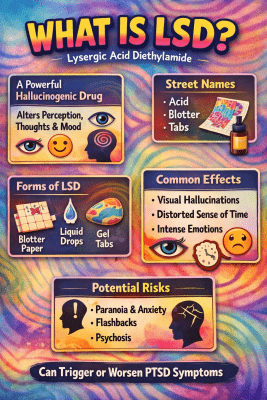
Lysergic acid diethylamide, commonly known as LSD or simply “acid,” is one of the most potent psychoactive substances ever discovered. Its history is a remarkable journey that spans accidental discovery, scientific promise, cultural revolution, political prohibition, and now a long-awaited medical renaissance.
For over 80 years, this compound has influenced psychiatry, neuroscience, art, music, and public policy. Today, as researchers around the world investigate LSD’s potential to treat conditions like PTSD, depression, and anxiety disorders, understanding its complete history has never been more relevant.
This comprehensive guide explores the full story of LSD from a Swiss laboratory accident to the forefront of modern psychedelic medicine.
Chapter 1: The Accidental Discovery (1938-1943)
The Man Behind the Molecule: Albert Hofmann
The story of LSD begins with a brilliant Swiss chemist named Albert Hofmann. Born in Baden, Switzerland, in 1906, Hofmann earned his doctorate in chemistry from the University of Zurich in 1929. That same year, he joined the pharmaceutical-chemical research laboratory of Sandoz Laboratories (now a subsidiary of Novartis) in Basel, Switzerland.
Hofmann’s initial work focused on natural products, particularly the active principles of medicinal plants. His early research involved studying Mediterranean squill (Scilla maritima) and elucidating the chemical structure of cardiac glycosides.
The Ergot Connection
Hofmann’s path to LSD began with his interest in ergot (Claviceps purpurea), a fungus that grows on rye and other grains. Ergot has a dark history it caused mass poisonings throughout the Middle Ages known as “St. Anthony’s Fire,” characterized by gangrene and convulsions.
However, ergot also contains valuable medicinal alkaloids. In 1918, Professor Arthur Stoll, the founder and director of Sandoz’s pharmaceutical department, had isolated ergotamine the first pure ergot alkaloid used to treat migraines and postpartum hemorrhage.
By the mid-1930s, Hofmann requested permission to resume ergot alkaloid research at Sandoz. Professor Stoll warned him of the difficulties: “These are exceedingly sensitive, easily decomposed substances, less stable than any of the compounds you have investigated“. Despite these warnings, Hofmann persisted.
The 25th Derivative
On November 16, 1938, Hofmann synthesized the 25th in a series of lysergic acid derivatives while researching compounds that could act as circulatory and respiratory stimulants–. He named it LSD-25 (Lysergic Acid Diethylamide).
Initial animal testing showed no remarkable effects, and the compound was set aside forgotten for five years.
The First Accidental Trip
On April 16, 1943, Hofmann decided to reexamine LSD-25. While resynthesizing the compound, he accidentally absorbed a small amount through his fingertips.
He later described the experience:
“I was affected by a remarkable restlessness, combined with a slight dizziness. At home I lay down and sank into a not unpleasant intoxicated-like condition, characterized by an extremely stimulated imagination. In a dreamlike state, with eyes closed (I found the daylight to be unpleasantly glaring), I perceived an uninterrupted stream of fantastic pictures, extraordinary shapes with intense, kaleidoscopic play of colors. After some two hours this condition faded away.”
Bicycle Day: The First Intentional Trip
Three days later, on April 19, 1943, Hofmann made a decision that would become legendary. He deliberately ingested 250 micrograms of LSD a dose he believed to be prudently small. He was wrong. The dose was actually quite strong.
As the effects began intensifying, Hofmann rode his bicycle home from the laboratory, experiencing one of the most famous bike rides in scientific history. His trip was not initially pleasant: people appeared to morph into fantastic creatures, office furniture moved like living entities, and he felt possessed by otherworldly forces.
April 19 is now celebrated worldwide as “Bicycle Day” the birth date of the intentional psychedelic experience.
Chapter 2: The Golden Age of Psychedelic Research (1940s-1960s)
Sandoz Recognizes the Potential
Following Hofmann’s discovery, Sandoz Pharmaceuticals recognized LSD’s extraordinary properties and began distributing it to researchers worldwide. Between the 1940s and 1960s, over 1,000 scientific articles were published on LSD’s therapeutic applications.
During this period, more than 40,000 patients were administered LSD in clinical trials. Researchers explored its potential for treating a wide range of conditions.
Therapeutic Breakthroughs
Alcoholism Treatment: One of the most promising applications was treating alcohol dependence. LSD appeared to “compress years of psychotherapy into a single, intensive, self-reflective session,” helping patients achieve a new self-image and the willpower to move beyond their addiction.
Psychotherapy Adjuvant: Psychiatrists used LSD as a tool to help patients access repressed memories and traumatic experiences. The compound seemed to lower psychological defenses, allowing deeper therapeutic work.
Palliative Care: Researchers found that LSD could help terminally ill patients face death without fear. Aldous Huxley, the author of Brave New World, famously received LSD on his deathbed in 1963, describing an experience of “warmth and spiritual belonging”.
Psychosis Modeling: Scientists used LSD to temporarily induce psychosis-like states, hoping to better understand schizophrenia and other mental illnesses.
The Birth of the Term “Psychedelic”
In 1957, British psychiatrist Humphry Osmond coined the term “psychedelic“ from the Greek words psyche (mind) and delos (manifesting) meaning “mind-manifesting.” Osmond believed this term better captured LSD’s potential for revealing hidden aspects of consciousness compared to terms like “psychotomimetic” (psychosis-mimicking).
Chapter 3: The Dark Interlude (1950s-1960s)
While legitimate medical research flourished, darker forces were also taking an interest in LSD.
Nazi Interest and Experiments
According to historian Norman Ohler, author of Tripped: Nazi Germany, the CIA and the Dawn of the Psychedelic Age, Nazi Germany became interested in LSD during World War II. The regime was searching for a “truth drug” to extract information from prisoners and interrogate opponents.
Sandoz CEO Arthur Stoll shared information and samples of the new compound with Richard Kuhn, a Nobel Prize-winning German chemist who was also “Hitler’s leading biochemist.” SS documents describe tests conducted at the Dachau concentration camp using LSD as part of this research.
The CIA’s Project MK-Ultra
After World War II, American intelligence became fascinated with LSD. When American forces liberated Dachau, they found SS reports on LSD research and became intensely interested.
The CIA launched Project MK-Ultra a covert mind-control research program that examined the effects of psychoactive drugs on human subjects, often without their knowledge or consent.
The program’s goals were extraordinary and unsettling:
-
Developing a “truth drug” for interrogating Soviet spies
-
Exploring LSD as a potential chemical weapon
-
Investigating whether LSD could be used to disable enemy forces or entire populations
In one infamous incident, army chemist Frank Olson was unwittingly dosed with LSD in 1953. He later died after jumping from a New York hotel room window.
While the CIA ultimately failed to develop a reliable mind-control weapon, MK-Ultra represented a profound ethical violation and contributed to LSD’s dangerous reputation.
Chapter 4: The Counterculture Explosion (1960s)
From Laboratory to Streets
By the early 1960s, LSD had escaped the confines of academic research and entered the public sphere. University campuses became hubs of psychedelic experimentation, and word spread rapidly through underground networks.
The Psychedelic Evangelists
Several influential figures championed LSD’s potential for consciousness expansion:
Timothy Leary, a Harvard psychologist, became the most famous advocate of psychedelic use after being dismissed from Harvard for his research. His famous phrase “Turn on, tune in, drop out” became a rallying cry for the counterculture generation.
Aldous Huxley, already famous for Brave New World, documented his experiences with mescaline in The Doors of Perception and became an influential voice for psychedelic exploration.
The Beatles incorporated psychedelic themes into their music, with songs like “Lucy in the Sky with Diamonds” widely interpreted as references to LSD.
The Summer of Love and Cultural Revolution
By the mid-1960s, LSD had become inextricably linked with the counterculture movement the hippie generation, anti-war protests, psychedelic art, and experimental music. The Haight-Ashbury district of San Francisco became ground zero for the psychedelic revolution.
However, this cultural embrace of LSD also brought fear and backlash from mainstream society. News reports of “bad trips,” psychotic episodes, and accidents involving LSD users fueled public anxiety.
Chapter 5: Criminalization and the Research Blackout (Late 1960s-2010s)
The Legal Crackdown
By the mid-1960s, scientific criticism of LSD had become somewhat “moot” research came to a “decided halt” as the drug became synonymous with countercultural activities, hedonism, and drug abuse.
In 1968, the United States federal government criminalized LSD, classifying it as a Schedule I controlled substance defined as having “no accepted medical use and a high potential for abuse”.
Other countries followed suit throughout the 1970s. LSD research effectively ended for nearly 50 years.
The Consequences of Prohibition
The criminalization had devastating effects on scientific progress:
“From that moment on, it was illegal to manufacture LSD and also research with LSD. So from the 1960s until about 2015, there was basically no LSD research anywhere.” Norman Ohler
British pharmacologist David Nutt famously published a harm-ranking scale in The Lancet in 2007, demonstrating that psychedelic drugs were much less harmful than legal substances like nicotine and alcohol. He was subsequently fired from his position on the UK’s Advisory Council on the Misuse of Drugs
Nutt later lamented the “daunting bureaucratic labyrinth that can dissuade even the most committed investigator”
Chapter 6: The Psychedelic Renaissance (2010s-Present)
Breaking the Research Freeze
Beginning around 2010, a new generation of researchers began systematically reopening investigation into psychedelic medicine.
In 2016, researchers published the first modern neuroimaging study of LSD’s effects in the brains of healthy volunteers a landmark study that demonstrated the compound’s unique effects on brain connectivity.
Modern Research Findings
Today, research into LSD and other psychedelics has expanded dramatically. According to the GESDA Science Breakthrough Radar:
“The field has expanded from a few labs examining an exotic topic in neuroscience into an extensive network of academic laboratories and dedicated university centres in prestigious institutions. This work is being conducted around the world but is concentrated within the UK, USA, Switzerland, Spain and Brazil.”
Current research focuses on LSD’s potential for:
-
Treatment-resistant depression
-
PTSD (Post-Traumatic Stress Disorder)
-
Substance use disorders and addiction
-
End-of-life anxiety in terminally ill patients
In June 2023, the largest ever conference on the topic, Psychedelic Science 2023, took place in Denver, Colorado, with approximately 500 speakers and 12,000 participants from many countries.
A Different Approach: Psychedelic-Assisted Therapy
Modern researchers emphasize that LSD is not being studied as a daily medication. Instead, it is administered in a carefully controlled framework called Psychedelic-Assisted Therapy (PAT):
-
Preparation sessions with psychotherapists before the medication session
-
The medication session itself, where the patient receives LSD in a safe, supervised environment, typically lying down with eyes closed and listening to instrumental music
-
Integration sessions following the experience to help patients process and apply insights gained
This structure acknowledges that the psychedelic experience itself not just the chemical is central to therapeutic outcomes.
Chapter 7: Albert Hofmann’s Legacy
A Long Life of Advocacy
Albert Hofmann lived to the remarkable age of 102, passing away on April 29, 2008. Throughout his long life, he remained an advocate for LSD’s responsible use and medical potential.
In his memoir, LSD: My Problem Child, Hofmann wrote:
“I see the true importance of LSD in the possibility of providing material aid to meditation aimed at the mystical experience of a deeper, comprehensive reality.”
On his 100th birthday, Hofmann described LSD as “medicine for the soul“ and expressed frustration with its worldwide prohibition.
A Complex Legacy
Hofmann always hoped for LSD’s therapeutic potential to be realized. In 2008, just before his death, he learned that Switzerland his home country was reopening LSD research. He was reportedly overjoyed.
He continued taking small doses of LSD throughout his life and maintained that if used responsibly, the substance offered profound benefits for human consciousness and well-being.
Chapter 8: LSD Today and Tomorrow
Current Legal Status
LSD remains a Schedule I controlled substance in the United States and is similarly restricted in most countries worldwide. However, a growing number of jurisdictions are creating pathways for approved research:
-
Switzerland has permitted carefully controlled therapeutic research
-
Several US states have decriminalized possession or are exploring psychedelic-assisted therapy frameworks
-
Australia has created pathways for MDMA and psilocybin therapy (though LSD remains restricted)
The Ethical Challenges Ahead
As psychedelic medicine advances, researchers and policymakers face important questions:
Scaling training: Guiding patients through psychedelic experiences requires specialized training. Scaling this training to meet potential demand requires educating thousands of practitioners.
Healthcare integration: The psychedelic therapy model combining medication with intensive psychotherapeutic support does not fit easily into existing healthcare systems designed for daily pills.
Indigenous knowledge: Many psychedelic compounds have been used by indigenous peoples for millennia. The emerging psychedelic industry must address concerns around intellectual property, social justice, and respectful collaboration with these communities.
Access and equity: Ensuring that these promising treatments reach all who might benefit not just those who can afford expensive therapy is a crucial challenge.
Conclusion: From Problem Child to Promise
The history of LSD is one of science, serendipity, scandal, and now hope.
From a Swiss laboratory in 1938, through the CIA’s secret programs and the counterculture explosion, to a 50-year research blackout and finally a modern renaissance, LSD has traveled an extraordinary path.
Today, we stand at a remarkable moment. The “daunting bureaucratic labyrinth” that David Nutt described is slowly being navigated. Researchers are publishing landmark studies. Governments are reconsidering prohibitions. And patients suffering from conditions that have resisted conventional treatment may soon have new options.
Albert Hofmann’s “problem child” may finally be maturing into a legitimate medicine. Whether this promise is fulfilled depends on rigorous science, thoughtful regulation, and a willingness to learn from both the triumphs and mistakes of the past
Key Takeaways
| Period | Key Events |
|---|---|
| 1938 | Albert Hofmann first synthesizes LSD-25 at Sandoz Laboratories |
| 1943 | Hofmann accidentally discovers LSD’s psychoactive effects (April 16) and takes first intentional dose (April 19 – “Bicycle Day”) |
| 1940s-1960s | Golden age of psychedelic research; over 1,000 scientific papers published; 40,000+ patients treated |
| 1950s-1960s | Nazi interest and CIA’s MK-Ultra program explore LSD as a “truth drug” |
| 1960s | LSD becomes central to counterculture movement; Timothy Leary advocates widespread use |
| 1968 | LSD criminalized in the US; research effectively ends |
| 1970s-2010 | “Research blackout” period with virtually no clinical studies |
| 2010s | Psychedelic renaissance begins; modern neuroimaging studies emerge |
| 2023 | Largest psychedelic science conference held in Denver (12,000+ participants) |
| Present | LSD research continues for PTSD, depression, addiction, and palliative care |
Frequently Asked Questions
Albert Hofmann, a Swiss chemist working at Sandoz Laboratories in Basel, Switzerland, first synthesized LSD in 1938 and discovered its psychoactive effects in 1943.
LSD stands for Lysergic Acid Diethylamide (LSD-25 was the 25th derivative Hofmann synthesized).
On April 19, 1943, Albert Hofmann deliberately ingested 250 micrograms of LSD and rode his bicycle home from the laboratory—the first intentional LSD trip in history.
No. For approximately 20 years (late 1940s-1960s), LSD was legal and actively researched for medical applications. It was criminalized in the US in 1968.
Yes. The CIA’s Project MK-Ultra conducted covert research on LSD and other psychoactive substances, often without subjects’ knowledge or consent. This program was revealed in the 1970s.
Yes. Researchers worldwide are studying LSD for PTSD, treatment-resistant depression, substance use disorders, and end-of-life anxiety under carefully controlled clinical trial conditions.
PAT is a structured therapeutic framework combining limited psychedelic administration with extensive psychological preparation and integration. It is not daily medication but intensive therapy.
Research suggests LSD is not associated with compulsive patterns of use or physical dependence. However, tolerance builds rapidly, requiring significant breaks between uses for effects to return.
References & Further Reading
-
Dyck, E. (2015). “LSD: a new treatment emerging from the past.” CMAJ, 187(14), 1079-1080.
-
Hofmann, A. LSD: My Problem Child.
-
Ohler, N. Tripped: Nazi Germany, the CIA and the Dawn of the Psychedelic Age.
-
Drug Science. (2022). “LSD Educational Resources.”
-
GESDA Science Breakthrough Radar. “The Future of Psychedelic Medicine.”
Disclaimer: This content is for educational and historical purposes only. LSD remains a controlled substance in most jurisdictions. Psychapotheke does not encourage or condone illegal activity. Always consult a licensed healthcare provider for medical advice and verify your local laws regarding controlled substances.
Published by Psychapotheke — Education. Safety. Science.