LSD vs Magic Mushrooms: A Complete Science-Based Comparison
Lsd Vs Magic Mushrooms Medically reviewed by: Clinical research data from University Hospital Basel, Switzerland
Fact-checked: Last updated April 9th 2026
Introduction: Two Classic Psychedelics, One Important Question
Lysergic acid diethylamide (LSD) and psilocybin mushrooms (commonly known as “magic mushrooms” or “shrooms”) are two of the most widely studied classic psychedelics . Both have a long history of cultural use and growing interest in clinical research for conditions like depression, anxiety, PTSD, and addiction .
But what are the real differences between LSD and psilocybin? Does one work better for specific mental health conditions? How do their durations, effects, and safety profiles compare?
This guide provides an evidence-based, side-by-side comparison using data from clinical trials, neuroimaging studies, and head-to-head research conducted at leading institutions like the University Hospital Basel .
Disclaimer: This content is for educational and harm-reduction purposes only. Psychapotheke does not encourage illegal use of controlled substances.
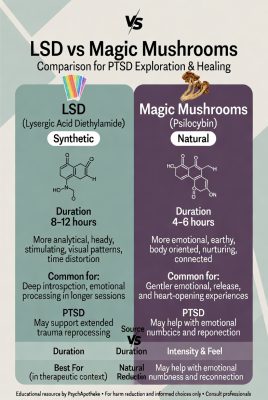
At a Glance: LSD vs Magic Mushrooms Comparison Table
| Feature | LSD (Acid) | Magic Mushrooms (Psilocybin) |
|---|---|---|
| Origin | Synthetic (derived from ergot fungus) | Naturally occurring fungus |
| Active Compound | Lysergic acid diethylamide | Psilocybin (converted to psilocin) |
| Primary Receptor | 5-HT2A (serotonin), plus dopamine D1-3 | 5-HT2A, serotonin transporter inhibition |
| Typical Duration | 8–12 hours | 4–6 hours |
| Onset of Effects | ~60 minutes | ~60 minutes |
| Peak Experience | Hours 2–4 | Hours 1.5–3 |
| Common Dose Range | 50–200 µg | 10–30 mg psilocybin (~1–3g dried mushrooms) |
| Experience Character | More “cerebral,” analytical | More “whole-body,” emotional |
| Therapeutic Focus | Anxiety, alcohol use disorder | Depression, end-of-life anxiety, addiction |
Sources: Technology Networks, 2023 ; Odyssey PBC, 2025
Chemical Composition and Origins
LSD: The Synthetic Psychedelic
LSD is a semi-synthetic compound derived from ergot, a fungus that grows on rye and other grains. It was first synthesized in 1938 by Swiss chemist Albert Hofmann, who accidentally discovered its psychoactive properties in 1943. LSD is typically produced in a laboratory setting and is active at microgram doses , making it one of the most potent psychedelics known .
Magic Mushrooms: Nature’s Entheogen
Psilocybin mushrooms are naturally occurring fungi that grow in tropical and subtropical regions worldwide. The mushrooms contain the psychoactive compound psilocybin, which the body converts to psilocin the molecule responsible for the hallucinogenic effects. Unlike LSD, psilocybin mushrooms have been used for thousands of years in indigenous spiritual and healing rituals across Mesoamerica.
How They Affect the Brain: Mechanisms of Action
Both LSD and psilocybin exert their primary effects through the serotonin 2A (5-HT2A) receptor in the brain. However, their receptor interaction profiles differ significantly .
LSD’s Unique Receptor Profile
LSD is a “dirty” drug in pharmacological terms meaning it interacts with multiple receptor types :
-
5-HT2A, 5-HT2B, 5-HT2C (serotonin receptors)
-
5-HT1A (another serotonin receptor)
-
D1, D2, D3 (dopamine receptors)
This broader receptor activity may explain why LSD is often described as more “cerebral” or “analytical” compared to psilocybin.
Psilocybin’s Mechanism
Psilocin (the active metabolite of psilocybin) has a more focused profile:
-
5-HT2A receptor (primary psychedelic effects)
-
Serotonin transporter inhibition (may enhance emotional processing)
-
Minimal dopamine activity unlike LSD
Research from the University Hospital Basel found that despite these pharmacological differences, the subjective effects of equivalent doses are remarkably similar suggesting that dosing and duration may matter more than the specific compound for therapeutic outcomes .
Duration and Intensity: A Critical Difference
The most significant practical difference between LSD and psilocybin is duration of action.
| Substance | Total Duration | Peak Experience | Comedown |
|---|---|---|---|
| Psilocybin | 4–6 hours | 1.5–3 hours | Gradual, often gentle |
| LSD | 8–12 hours | 2–4 hours | Prolonged, can be tiring |
Source: University Hospital Basel clinical trials Lsd Vs Magic Mushrooms
What This Means for Users
-
Shorter sessions (psilocybin): More suitable for controlled clinical environments with limited time; less demanding on patients
-
Longer sessions (LSD): Allows for deeper psychological exploration but requires more intensive supervision and preparation
A 2025 head-to-head study confirmed that psilocybin’s effects resolve significantly faster than LSD’s, which may be an important consideration for therapy scheduling .
Subjective Experience: How They Feel
LSD: The “Cerebral” Experience
Users commonly describe LSD as:
-
More analytical and introspective
-
Visual distortions (patterns, waves, enhanced colors)
-
Time distortion (hours can feel like days)
-
Greater sense of mental clarity (paradoxically)
-
More likely to produce “ego dissolution” at higher doses
Magic Mushrooms: The “Emotional” Journey
Psilocybin is often characterized by:
-
More body-focused sensations (“whole-body high”)
-
Emotional release (crying, laughing, profound empathy)
-
Nature-connectedness (feeling merged with environment)
-
Often described as more “organic” or “earthy” than LSD
-
Higher reported rates of nausea during onset
Do They Feel Different? The Science Says…
A landmark 2023 study published in Neuropsychopharmacology found that when given at equivalent moderate-to-high doses, healthy participants could not reliably distinguish between LSD, psilocybin, and mescaline .
The researchers concluded:
“These findings indicate that any differences in alterations of consciousness induced by mescaline, LSD, and psilocybin are dose-dependent rather than substance-dependent.”
In other words: set, setting, and dosage may matter more than which substance you take .
Therapeutic Applications: Which Works for What?
Clinical research suggests that LSD and psilocybin may have different therapeutic strengths.
Psilocybin: Strongest Evidence for Depression
| Condition | Evidence Strength | Key Finding |
|---|---|---|
| Major Depressive Disorder | Strong | Large effect size (Hedges’ g ≈ 1.05) |
| Treatment-Resistant Depression | Strong | 71% response rate after two sessions |
| End-of-Life Anxiety | Strong | 80% sustained benefit at 6 months |
| Alcohol Use Disorder | Moderate | Significant reduction in heavy drinking days |
| Smoking Cessation | Moderate | 73% abstinence at 6 months (Johns Hopkins) |
*Source: Umbrella review of 23 meta-analyses, 2025 * Lsd Vs Magic Mushrooms
LSD: Promising for Anxiety and Alcoholism
| Condition | Evidence Strength | Key Finding |
|---|---|---|
| Anxiety (with/without life-threatening illness) | Moderate-strong | Benefits lasting up to 16 weeks |
| Alcohol Use Disorder | Moderate | Odds ratio ≈ 2.0 for reduced drinking |
| Depression | Preliminary | Often studied alongside anxiety |
*Source: Umbrella review of 23 meta-analyses, 2025 *
Expert Take
“Psilocybin appears most effective for depression, while LSD appears most effective for anxiety. This often leads to personalized treatment, where medical professionals choose the substance based on a patient’s primary condition.”
Safety Profiles and Side Effects
Both substances have favorable safety profiles when used in controlled medical settings, with no evidence of organ damage or physiological addiction.
Common Side Effects (During Experience)
| Side Effect | LSD | Psilocybin |
|---|---|---|
| Nausea | Mild | Moderate (30-40%) |
| Increased heart rate | Trend higher | Mild |
| Increased blood pressure | Mild | Higher diastolic |
| Pupil dilation | Yes | Yes |
| Anxiety/paranoia | Possible | Possible |
| Headache | Post-experience | Post-experience |
Source: Technology Networks, 2023 Lsd Vs Magic Mushrooms
Serious Risks (Rare in Clinical Settings)
-
Psychological distress (“bad trip”) minimized by proper set/setting
-
Hallucinogen Persisting Perception Disorder (HPPD) rare, more common with chronic use
-
Psychotic episodes primarily in individuals with personal or family history of psychosis
Contraindications
Both substances are not recommended for individuals with:
-
Schizophrenia or psychotic disorders
-
Bipolar I disorder
-
Personal or family history of psychosis
-
Uncontrolled heart conditions
Dosage: A Critical Comparison
LSD Dosing (Oral)
| Dose | Effect |
|---|---|
| 20–50 µg | Microdose (sub-perceptual) |
| 50–100 µg | Mild experience (enhanced mood, subtle visuals) |
| 100–200 µg | Full psychedelic experience (standard therapeutic dose) |
| 200–400 µg | Intense experience (significant ego dissolution) |
Psilocybin Dosing (Oral)
| Dose | Equivalent Dried Mushrooms | Effect |
|---|---|---|
| 1–3 mg | 0.1–0.3g | Microdose |
| 5–10 mg | 0.5–1g | Mild (enhanced perception) |
| 10–20 mg | 1–2g | Moderate psychedelic |
| 20–30 mg | 2–3.5g | Full psychedelic experience |
| 30+ mg | 3.5g+ | Intense experience |
Note: 20 mg of psilocybin is approximately equivalent in subjective effect intensity to 100 µg of LSD, according to the University Hospital Basel study .
Routes of Administration
LSD Ingestion Methods
-
Blotter paper: Small paper squares soaked in LSD solution, placed on or under the tongue
-
Liquid drops: Measured drops added to water or directly onto the tongue
-
Sugar cubes: Absorbent cubes dosed with liquid LSD
-
Gel tabs: Gelatin squares containing LSD
LSD is never smoked or snorted in typical use .
Psilocybin Mushroom Consumption
-
Eating dried mushrooms: Most common method; taste can be strong
-
Mushroom tea: Brewed to reduce nausea and speed onset
-
Capsules: Ground mushrooms in pill form (tasteless)
-
Mixed with food: Peanut butter, chocolate, or smoothies to mask taste
Brewing tea may reduce nausea because chitin (a compound in mushroom cell walls) is partially broken down .
Tolerance and Addiction Potential
Tolerance Development
Both LSD and psilocybin produce rapid tolerance with repeated use:
-
Tolerance builds after a single dose
-
Cross-tolerance exists between LSD and psilocybin (taking one reduces response to the other)
-
Baseline sensitivity typically returns after 7–14 days of abstinence
Addiction Potential
Neither LSD nor psilocybin is considered physically addictive:
-
No withdrawal syndrome
-
No compulsive redosing behavior (tolerance prevents frequent use)
-
Low abuse potential compared to alcohol, nicotine, or opioids
However, psychological dependence can develop in rare cases, particularly with frequent use.
Legal Status
United States (Federal)
Both LSD and psilocybin remain Schedule I controlled substances defined as having “no accepted medical use and high abuse potential.”
However, the FDA has granted Breakthrough Therapy designation to both:
-
Psilocybin for treatment-resistant depression (COMPASS Pathways)
-
LSD for generalized anxiety disorder (MindMed)
State-Level Progress (US)
Legal for therapeutic use:
-
Oregon (psilocybin therapy centers operational)
-
Colorado (psilocybin therapy begins 2025)
Decriminalized:
-
Washington DC, Detroit, Seattle, Oakland, Santa Cruz, and others
International
| Country | LSD Status | Psilocybin Status |
|---|---|---|
| Germany (DE) | Schedule I (BtMG) | Schedule I (BtMG) |
| Canada | Schedule III | Schedule III |
| United Kingdom | Class A | Class A |
| Australia | Schedule 9 | Schedule 9 (except special access) |
| Netherlands | Illegal | Truffles legal; mushrooms restricted |
Head-to-Head Clinical Research
The most rigorous comparison to date comes from the University Hospital Basel’s LPM study (LSD, Psilocybin, Mescaline), which enrolled 32 healthy volunteers in a double-blind, placebo-controlled crossover trial.
Key Findings:
-
No qualitative differences in altered states of consciousness between equivalent doses
-
Participants could not reliably identify which substance they received
-
Duration was the only consistently distinguishable factor
-
Both substances were well-tolerated with no serious adverse events
“We found no evidence of qualitative differences in altered states of consciousness that were induced by 500 mg mescaline, 100 µg LSD, and 20 mg psilocybin.” LPM Study Researchers, 2023
Which Is Right for You? (Educational Only)
This information is for educational purposes and does not constitute medical advice.
| If your primary interest is… | May be more suitable |
|---|---|
| Depression treatment | Psilocybin (stronger evidence base) |
| Anxiety relief | LSD (promising trial results) |
| Shorter therapeutic session | Psilocybin (4–6 hours) |
| Deeper, longer exploration | LSD (8–12 hours) |
| Natural/organic preference | Psilocybin mushrooms |
| Precision dosing | LSD (synthetic, consistent potency) |
| Alcohol use disorder | Either (both have evidence) |
Frequently Asked Questions (FAQ)
At equivalent doses, neither is “stronger” — they produce subjectively similar effects. LSD lasts longer, which can feel more intense simply due to duration
Some users combine them (“hippie flip” or “soul bomb”), but this is not recommended for inexperienced users and has no clinical research support. Risks include unpredictable intensity and prolonged duration.
Standard urine drug tests do not typically screen for LSD or psilocybin. Specialized tests are required and are rare.
Yes. LSD and psilocybin have cross-tolerance — using one will reduce your response to the other for approximately 7–14 days
Both have excellent safety profiles in controlled settings. Psilocybin’s shorter duration may present fewer risks for adverse psychological reactions simply because the experience ends sooner
Current evidence is stronger for MDMA (Phase 3 trials completed), but both LSD and psilocybin are being studied for trauma-related conditions
Yes. Ketamine-assisted therapy is legal with a prescription in many regions. Breathwork (e.g., Holotropic), meditation, and integration coaching are fully legal alternatives
Conclusion: Similar Molecules, Different Timelines
The scientific evidence is clear: LSD and psilocybin produce remarkably similar subjective effects when taken at equivalent doses. The most significant practical difference is duration — LSD lasts roughly twice as long as psilocybin.
For therapeutic applications, psilocybin currently has stronger evidence for depression, while LSD shows particular promise for anxiety and alcohol use disorder .
Both substances are being actively studied in FDA-approved clinical trials, and both have received Breakthrough Therapy designations for specific indications .
As research continues, the choice between LSD and psilocybin may come down to:
-
Desired session length
-
Specific condition being treated
-
Patient preference (synthetic vs. natural)
-
Legal access (psilocybin is legal in Oregon and Colorado)
Final note from Psychapotheke: Whether you are a researcher, clinician, or informed individual, understanding the science behind these substances is the first step toward safe and responsible engagement. We provide education — not illegal products.
References
-
University Hospital Basel. (2024). Comparative Acute Effects of LSD, Psilocybin and Mescaline (LPM). ClinicalTrials.gov
-
Dominiak, M., et al. (2025). Efficacy and Safety of Psychedelics in Mental Disorder Cases: An Umbrella Review. Journal of Clinical Medicine
-
Opus Treatment. (2025). Acid vs Shrooms – Key Differences and Effects Explained
-
Technology Networks. (2023). LSD vs Mushrooms: Comparing Psychedelic Effects
-
Odyssey PBC. (2025). Psilocybin vs LSD for Mental Health: Complete 2025 Therapeutic Guide
-
Askariyan, K., et al. (2025). An overview of psilocybin, LSD, MDMA, and ketamine in revitalizing psychedelic-assisted therapy. ScienceDirect
Psychapotheke — Science. Safety. Psychedelic Education. Lsd Vs Magic Mushrooms