
DMT Safety & Harm Reduction: An Evidence‑Based Guide
Psychapotheke is committed to science‑based education and harm reduction. This guide synthesizes the latest clinical research, expert consensus, and community best practices to help you understand DMT Safety & Harm Reduction, the risks, benefits, and safer approaches associated with N,N‑Dimethyltryptamine (DMT).
Understanding DMT: A Brief Overview
DMT is a powerful serotonergic psychedelic found naturally in certain plants and animals, and it is also produced endogenously in the human body. It is the primary psychoactive component of ayahuasca and can also be smoked or vaporized as a purified extract. Unlike many other psychedelics, vaporized or injected DMT produces an extremely rapid onset (seconds to minutes) and a very short duration of action (typically 15–30 minutes), while oral DMT (combined with a monoamine oxidase inhibitor, MAOI) produces effects lasting several hours.
The Safety Profile: What Clinical Research Tells Us
Multiple recent clinical trials and systematic reviews have evaluated the safety and tolerability of DMT in healthy volunteers and patients with major depressive disorder (MDD). Key findings include:
-
No serious adverse events (SAEs) have been reported in early‑phase clinical trials across intravenous, inhaled, oral, and intranasal routes of administration. DMT is generally well‑tolerated–
-
Physiological effects such as increased blood pressure and heart rate are dose‑dependent and transient, resolving quickly without clinical sequelae.
-
Psychotomimetic effects (including ego dissolution and mystical‑type experiences) are dose‑dependent but manageable in controlled settings.
-
Inhaled (vaporized) DMT was found to be safe and well‑tolerated in a randomized double‑blind trial, with predominantly mild and transient adverse events–.
-
Intravenous DMT fumarate (SPL026) demonstrated an acceptable safety profile with no serious adverse events in a Phase 1 trial–.
🔬 Important caveat: Most clinical data come from small, short‑term studies in healthy, screened populations. Larger, long‑term studies are needed to fully establish DMT’s safety in broader patient groups, especially those with treatment‑resistant depression or complex medical histories.
Cardiovascular and Physiological Risks
DMT consistently produces transient increases in systolic blood pressure (up to 25.7 % in some studies) and heart rate. While these changes remain within safe limits for healthy individuals, they pose significant risks for people with certain medical conditions.DMT Safety & Harm Reduction
Potential physiological effects include:
-
Elevated heart rate and blood pressure
-
Dizziness, nausea, and vomiting (especially with oral/ayahuasca forms)
-
Mild throat or respiratory irritation (with inhalation)
-
Pupil dilation
-
Loss of coordination
These effects are generally short‑lived, but in vulnerable individuals they could trigger more serious events.
Psychological and Psychiatric Risks
DMT can produce overwhelming, frightening, or confusing experiences (sometimes called “bad trips”), especially in unprepared individuals or those with pre‑existing mental health vulnerabilities. Research suggests that approximately 9 % of non‑clinical users report functional difficulties lasting longer than a day after the acute effects, and in some cases these difficulties can persist for weeks, months, or even years.
Key psychological risks:
-
Triggering or worsening psychosis – DMT can increase the risk of psychotic episodes in individuals with a personal or family history of psychotic disorders (e.g., schizophrenia, schizoaffective disorder, bipolar 1 with psychotic features)
-
Exacerbation of anxiety, depression, or PTSD – Without proper support and integration, challenging experiences can retraumatize or destabilize vulnerable individuals.
-
Psychological dependence – While DMT does not typically produce physical dependence, some individuals may develop a psychological reliance on the altered state as an escape from emotional distress.
-
Post‑psychedelic difficulties – These may include anxiety, difficulty concentrating, intrusive thoughts, sleep disturbances, and excessive rumination about the experience–.
🧠 The myth of the “mental health breakthrough”: Recreational DMT use is not a substitute for evidence‑based therapy. Self‑medicating with DMT for conditions like PTSD or depression can complicate mental health and delay appropriate treatment–.
Absolute & Relative Contraindications
Based on clinical guidelines and expert consensus, DMT is contraindicated (should not be used) in the following situations:
Absolute Contraindications
| Category | Specific Conditions / Situations |
|---|---|
| Cardiovascular | Uncontrolled hypertension, heart failure, coronary artery disease, previous heart attack or stroke, severe arrhythmias |
| Neurological | Epilepsy or other seizure disorders |
| Psychiatric | Personal or family history of schizophrenia, schizoaffective disorder, bipolar 1 with psychosis, or other psychotic disorders |
| Pregnancy | Pregnancy or breastfeeding (risk to fetus/infant) |
| Medication interactions | Concurrent use of MAOIs, SSRIs, SNRIs, lithium, or other serotonergic agents (see Section 7) |
Relative Contraindications (higher risk, caution advised)
-
Unstable or poorly controlled mental health conditions
-
Active substance use disorder (especially alcohol, benzodiazepines, stimulants)
-
Significant trauma history without established coping skills or safety plan
-
Age under 21 or over 65 (limited safety data)
Note: These lists are not exhaustive. A thorough medical and psychiatric screening is essential before any DMT use, even in research settings.
Routes of Administration & Dosage Considerations
Different routes of administration produce vastly different pharmacokinetic and safety profiles. Below is a summary based on published data:
| Route | Onset | Peak | Duration | Typical Psychoactive Dose | Key Safety Notes |
|---|---|---|---|---|---|
| Smoked / Vaporized | 1–15 seconds | ~5 min | 20–60 min | 20–40 mg (common) | Rapid, intense onset; harsh smoke may cause coughing; transient BP/HR increase–– |
| Intravenous (IV) | Seconds | 5–10 min | 30–60 min | 10–21.5 mg (in trials) | Requires medical supervision; dose‑dependent BP/HR effects |
| Oral (with MAOI) | 30–90 min | 1.5–2 h | 4–6 h | 40–150 mg DMT (plus MAOI) | Risk of serotonin syndrome; MAOI drug interactions; nausea common |
⚠️ Critical warning: “Street” DMT products vary widely in purity and potency. Unknown adulterants (e.g., synthetic cannabinoids, 5‑MeO‑DMT, or other psychedelics) can dramatically increase risks. The community‑based harm‑reduction survey strongly advised against DMT for first‑time users due to its intensity and safety concerns.
Drug Interactions: A High‑Risk Area
DMT interacts with several classes of medications and substances, some of which can be life‑threatening.
⚠️ Serotonin Syndrome Risk
-
MAOIs (monoamine oxidase inhibitors): DMT combined with MAOIs (including the harmala alkaloids found in ayahuasca) can produce dangerously high serotonin levels, leading to serotonin syndrome (agitation, confusion, rapid heart rate, hyperthermia, seizures). MAOIs should be discontinued at least 14 days before DMT use–.
-
SSRIs / SNRIs: The combination of DMT with standard antidepressants may increase cardiovascular strain (blood pressure, heart rate) and potentially increase serotonin toxicity risk. Some evidence suggests SSRIs may also blunt the subjective effects of psychedelics, though data are conflicting.
Other Dangerous Combinations
| Substance / Drug Class | Potential Interaction |
|---|---|
| Lithium | May increase risk of seizures |
| Stimulants (e.g., amphetamines, cocaine) | Additive cardiovascular strain; increased risk of hypertensive crisis |
| Alcohol | May intensify confusion, anxiety, and physical side effects |
| Tramadol, linezolid, methylene blue | Increased serotonin toxicity risk |
🚨 Rule of thumb: Do not mix DMT with any medication that affects serotonin unless under strict medical supervision in a clinical trial setting.
The Set & Setting Framework
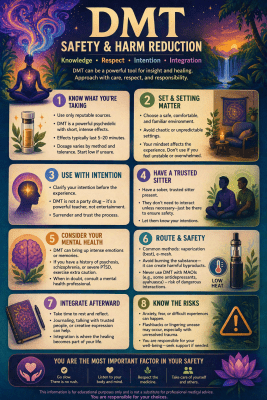
Even within a harm‑reduction framework, the most important modifiable factors for safety are mindset (“set”) and environment (“setting”).
Set (Internal State)
-
Intention: Clarify why you are considering DMT (healing, curiosity, spiritual exploration?). Vague or escapist intentions increase risk.
-
Mental state: Avoid DMT during periods of acute emotional distress, instability, or crisis.
-
Preparation: Learn about the substance, its effects, and potential risks. Consider speaking with an integration therapist beforehand.
Setting (External Environment)
-
Physical safety: Use a comfortable, private, safe space with no sharp objects, open flames, or hazards.
-
Sober sitter: A trusted, sober, and experienced guide should be present for the entire duration of the experience.
-
Medical backup: Ideally, have access to a person who can recognize and respond to medical emergencies (e.g., hypertensive crisis, panic reaction, seizure).DMT Safety & Harm Reduction
The psychedelic safety literature emphasizes that controlled conditions and screening substantially reduce adverse event rates compared to unmonitored environments.
Integration & Aftercare: The Essential Follow‑Up
The DMT experience does not end when the acute effects wear off. Integration the process of making sense of and embodying insights from the experience — is critical for long‑term safety and benefit. Without integration, even profound breakthroughs may remain disjointed or fade without lasting impact.
Recommended Integration Practices
-
Journaling: Write down memories, feelings, dreams, and synchronicities as soon as possible after the experience.
-
Talk therapy: Process the experience with a licensed therapist or trained integration coach. This is especially important if difficult emotions or trauma surfaced.
-
Body awareness: Gentle movement, yoga, or massage can help release stored emotions and integrate somatic insights.
-
Rest and self‑care: Allow at least one day off from work and responsibilities. Prioritize sleep, hydration, and nutrition–.
-
Peer support: Share your experience with trusted, non‑judgmental peers who understand psychedelic integration.
-
Create rituals: Light a candle, meditate, or return to a grounding natural setting to reinforce meaning.
-
Give it time: Integration unfolds over days, weeks, and even months. Avoid rushing to interpret everything immediately–.
🧘 If difficulties persist: Seek professional support. Prolonged anxiety, confusion, or intrusive thoughts following DMT use should be addressed by a mental health professional experienced in psychedelic integration.
Summary of Harm‑Reduction Principles
| Principle | Key Actions |
|---|---|
| Do your research | Understand pharmacology, risks, and contraindications before any use |
| Screen yourself | Be honest about medical and psychiatric history; if any absolute contraindications exist, do not use |
| Test your substance | Use reagent testing kits to check for adulterants (if you choose to use illegally — which we do not endorse) |
| Start low, go slow | Begin with threshold or low doses to assess individual sensitivity |
| Prepare your set | Stabilize mental health, set a clear intention, and avoid DMT during crisis |
| Control your setting | Use a safe, comfortable environment with a sober, experienced sitter |
| Avoid dangerous mixes | Never combine with MAOIs, SSRIs, stimulants, lithium, or alcohol |
| Plan for integration | Schedule therapy or journaling for days and weeks after the experience |
| Have emergency awareness | Know the signs of hypertensive crisis, panic reaction, and serotonin syndrome; have a plan to call emergency services if needed |
Legal & Ethical Note
In virtually all countries, including Germany, the United States, the United Kingdom, Canada, and Australia, DMT is a controlled substance and its possession, sale, or use outside of approved clinical research is illegal.
Psychapotheke does not sell, distribute, or facilitate the acquisition of illegal substance. Our mission is to provide science‑based education and harm reduction to reduce the risks associated with unregulated use. The safest legal way to experience DMT Safety & Harm Reduction is through participation in an approved clinical trial — not through illicit purchase.
Final Word
DMT is one of the most powerful psychedelics known to science. While early‑phase clinical trials suggest it has a favorable safety profile under controlled, medically supervised conditions, unmonitored use carries real and significant risks especially for individuals with underlying medical or psychiatric vulnerabilities. DMT Safety & Harm Reduction
Harm reduction does not mean encouragement. It means providing honest, evidence‑based information so that individuals can make informed decisions and reduce potential harms. If you are considering DMT for therapeutic purposes, we strongly encourage you to explore legal clinical trials and work with licensed healthcare providers rather than unregulated sources.
References (Selected)
-
Świeczkowski D, et al. Safety and tolerability of NN‑dimethyltryptamine (DMT) in healthy volunteers and MDD patients: A systematic review. Prog Neuropsychopharmacol Biol Psychiatry. 2025;140:111419.–
-
Wießner I, et al. Safety, tolerability and subjective effects of vaporized DMT: A randomized double‑blind clinical trial. Eur Neuropsychopharmacol. 2025;97:16‑27.–
-
Aragam G. Medical Contraindications to “Classic” Psychedelic Use. UCSF Psychedelic Blog. 2022.
-
Kruger DJ, et al. Best practices for first psychedelic experiences: harm reduction advice from the psychedelic community. Harm Reduct J. 2025;22(1):191.
-
Simonsson O, et al. On Minimizing Risk and Harm in the Use of Psychedelics. Psychiatric Research and Clinical Practice. 2025.
-
James E, et al. Safety, tolerability, pharmacodynamic and wellbeing effects of SPL026 (DMT fumarate) in healthy participants. Front Psychiatry. 2024;14:1305796.
-
Pine Grove Treatment. Is DMT Addictive? Dimethyltryptamine Abuse. 2025.
-
King F. Examining the Combined Use of Psychedelics and Psychiatric Drugs. Psychopharmacology Institute.
-
Erowid DMT Vault. Smoked/Vaporized DMT Dosages.–
-
Table 3. Ayahuasca Alkaloids: Route of Administration, Doses and Onset/Duration. Pharmaceuticals. 2020.
Psychapotheke — Science. Safety. Psychedelic Education.