

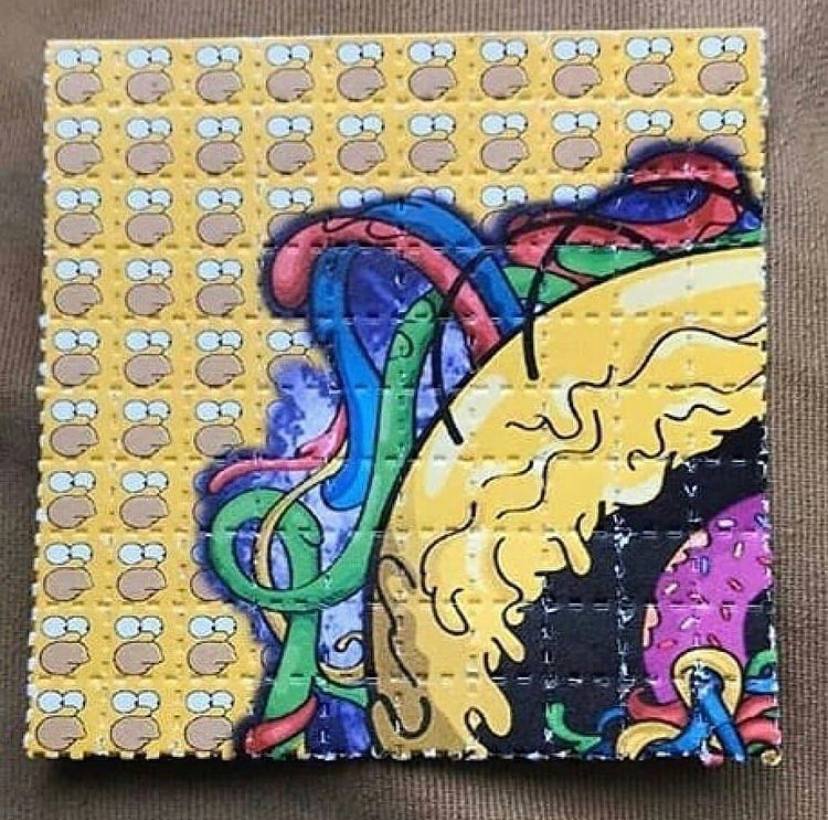
LSD Sheet
Price range: $90.00 through $420.00
Formula: C20H25N3O
IUPAC ID: (6aR,9R) N,N- diethyl- 7-methyl- 4,6,6a,7,8,9- hexahydroindolo- [4,3-fg] quinoline- 9-carboxamide
Duration of action: 8–12 hours
Onset of action: 30–40 minutes
Dose:
Microdose: (6-20 μg)
Mini-dose: (15-50 μg)
Moderate: dose (100-200 μg)
Mega dose: (250+ μg)
LSD Sheet: The Comprehensive Guide to Lsd Blotter Paper, Effects, Safety & Culture
Lysergic acid diethylamide (LSD) is one of the most potent and culturally significant psychedelics ever discovered. While the molecule itself is invisible and tasteless, its most iconic physical form is instantly recognizable: the LSD sheet, a square of absorbent paper printed with vivid designs and perforated into tiny tabs. This guide explores every facet of the LSD sheet, from its chemistry and history to its role in art, law, and personal safety.

What Is an LSD Sheet?
An LSD sheet, also called a blotter or blotter paper, is a sheet of absorbent paper that has been infused with liquid LSD. The paper is usually printed with colorful artwork and then perforated into small squares, each about 5 mm × 5 mm (roughly a quarter-inch), with a single sheet often containing up to 900 individual doses. These individual squares are known as tabs, hits, or trips. In street terminology, a single dose is a “hit,” 10 hits make a “strip” (or “ten-strip”), and 10 strips constitute a full “sheet”.
Blotter is the most common delivery method for LSD because the drug is active at extraordinarily small doses typically 50 to 200 micrograms (µg) making it impractical to handle in pure crystal form. The paper acts as a carrier medium, allowing for easy storage, transport, and measured dosing.
Related terms: blotter paper, acid tabs, LSD tabs, blotter acid, acid blotter, LSD blotter, psychedelic blotters, lysergic acid diethylamide sheets, paper acid.
How LSD Sheets Are Made
The production of an LSD sheet begins with the synthesis of crystalline LSD. The crystal is dissolved into a liquid solution, typically a mixture of water and alcohol. Large sheets of highly absorbent blotting paper are then dipped into this solution, saturated, and hung to dry. Once dry, the sheet is perforated into individual tabs for convenient dosing.
Because LSD is colorless, odorless, and tasteless in its pure form, the printed designs on blotter paper serve multiple functions: they act as camouflage, aid in brand identification, and sometimes indicate dosage or batch origin–. The graphics are applied before the paper is dipped, and the ink does not interfere with the drug’s potency.
Key production terms: LSD crystal synthesis, blotter dipping process, perforated sheets, carrier medium, LSD solution.
A Brief History of LSD and Blotter Paper
LSD was first synthesized on November 16, 1938, by Swiss chemist Albert Hofmann at Sandoz Laboratories in Basel. Working with derivatives of lysergic acid found in ergot (a fungus that grows on rye), Hofmann created LSD-25, but initial animal tests showed little promise, and the compound was shelved. Five years later, in 1943, Hofmann accidentally ingested a small amount and experienced the world’s first LSD trip a bicycle ride home that became legendary in psychedelic history.
During the 1950s and early 1960s, Sandoz marketed LSD under the name Delysid for psychiatric research, and thousands of studies explored its therapeutic potential. However, recreational use exploded within the counterculture movement, and LSD was banned in the United States in 1965 (federally in 1968) and in the United Kingdom in 1966.
Blotter paper emerged as the primary distribution method in the early 1970s, following the ban. It was a response to law enforcement pressure: sheets of paper could be mailed inconspicuously across borders, and the visual designs provided a layer of disguise. The underground blotter trade quickly evolved into an art form, with increasingly elaborate and subversive imagery appearing on tabs.
Historical milestones: Albert Hofmann discovery, Sandoz Delysid, 1960s counterculture, LSD criminalization, rise of blotter paper in the 1970s.
Dosage and Effects: What Happens When You Take a Tab
Typical Dosage Range
A single LSD tab typically contains between 50 and 200 micrograms (µg) of LSD, though doses can vary widely from near-zero (placebo tabs) to over 300 µg in rare cases. The threshold for perceptible psychedelic effects is around 20–25 µg, with a clear dose-response relationship up to approximately 200 µg. Historical tabs from the 1960s–1970s often contained 100–200 µg or more; modern street tabs generally fall in the 20–80 µg range.
| Dose (µg) | Expected Effects |
|---|---|
| 5–20 | Subtle mood lift, mild sensory enhancement |
| 25–50 | Perceptual changes, visual distortions, emotional openness |
| 50–100 | Full psychedelic effects: vivid hallucinations, ego dissolution, time distortion |
| 100–200 | Intense peak experience, profound synesthesia, potential anxiety or overwhelming states |
| 200+ | Extended duration (10+ hours), strong ego loss, possible panic reactions |
Pharmacological Mechanism
LSD exerts its primary psychedelic effects by acting as a partial agonist at serotonin 5-HT2A receptors in the brain. It also interacts with other serotonin receptor subtypes and dopamine receptors, contributing to its complex profile. The drug has a half-life of approximately 3 hours, with subjective effects lasting 6–11 hours depending on dose–.
Subjective Effects
Under the influence of LSD, users may experience:
-
Visual hallucinations: intensified colors, geometric patterns, tracers, and morphing objects
-
Synesthesia: “hearing colors” or “seeing sounds”
-
Altered sense of time and self (ego dissolution)
-
Heightened emotional states and introspection
-
Spiritual or mystical-type experiences.
Physiological effects include dilated pupils, increased heart rate and blood pressure, elevated body temperature, sweating, dry mouth, loss of appetite, insomnia, and tremors.
Factors Influencing the Experience
The LSD trip is notoriously unpredictable. The same dose taken by the same person can produce dramatically different experiences depending on set (the user’s mindset) and setting (the physical and social environment)–. Other variables include mixing with other substances, physical health, and prior psychedelic experience.
Safety, Risks, and Harm Reduction
While LSD is physically non-toxic and has no known lethal overdose level, it carries significant psychological risks. Panic reactions, paranoia, and dangerous behavior can occur, especially at high doses or in unsafe environments. A “bad trip” can be deeply distressing and may have lasting psychological consequences.
Best Practices for Safer Use
If someone chooses to use LSD, the following harm reduction strategies are widely recommended:
-
Test your substance. Use reagent testing kits to verify the presence of LSD and rule out dangerous adulterants such as NBOMe compounds, which are often sold on blotter paper and can cause severe toxicity, seizures, and death–.
-
Start with a low dose. If you are inexperienced or unsure of the tab’s potency, begin with half a tab or less. Wait at least one hour before considering re-dosing.
-
Choose a safe environment. Be in a comfortable, familiar place with trusted companions. Avoid crowds, unsafe heights, water bodies, and situations requiring complex motor skills.
-
Prepare your mindset. Avoid psychedelics if you are feeling anxious, depressed, or emotionally unstable. A calm, curious, and open attitude reduces the risk of a difficult experience.
-
Have a sober trip-sitter. A trusted friend who remains sober can provide reassurance and practical help if the trip becomes challenging.
-
Stay hydrated and nourished. Drink water and eat a light meal beforehand. Avoid mixing with alcohol, stimulants (cocaine, amphetamines), or tramadol, which can increase health risks.
-
Manage a bad trip. Dim the lights, play calming music, practice slow breathing, and remind yourself (or the person you’re helping) that the experience is temporary. Surrender to the experience rather than fighting it–.
Harm reduction keywords: LSD safety, trip-sitting, reagent testing, NBOMe detection, set and setting, drug checking, psychedelic harm reduction.
Legal Status and Sentencing of Lsd Blotter
LSD is classified as a Schedule I controlled substance in the United States and under equivalent laws internationally (e.g., the UN Convention on Psychotropic Substances). Manufacturing, distribution, or possession of LSD carries severe criminal penalties–.
A critical legal nuance concerns the weight of the blotter paper itself. Courts in multiple jurisdictions have ruled that the total weight of the LSD-impregnated paper not just the microgram quantity of the drug should be used to determine offense severity. In the United States, federal sentencing guidelines treat each dose on a carrier medium as equivalent to 0.4 mg of LSD for sentencing purposes, which can dramatically increase mandatory minimum sentences–. In India, the Karnataka High Court similarly held that blotter paper weight counts toward the “commercial quantity” threshold, which triggers 10–20 years of imprisonment.
Possession of a single sheet (often 100–900 doses) can therefore be prosecuted at the same level as possessing grams of pure LSD, leading to decades-long sentences.
Legal keywords: LSD scheduling, controlled substance, blotter paper weight, mandatory minimum sentencing, commercial quantity.
The Art of the LSD Sheet
One of the most fascinating dimensions of the LSD sheet is its visual culture. Blotter art originated in the early 1970s as an underground method of branding and identifying different batches of LSD. Over time, the designs evolved into a legitimate if controversial art form, now exhibited in galleries and collected by enthusiasts worldwide.
The largest archive of blotter art is the Institute of Illegal Images, founded by San Francisco-based artist and collector Mark McCloud. His collection, estimated to contain over 33,000 sheets, surpasses even those of the FBI and DEA.
In the fine art world, the LSD Portfolio (2013–2015) commissioned by publisher Rob Tufnell invited contemporary artists including Jeremy Deller, Laura Owens, and Mark Leckey to design their own blotter sheets (without LSD). Deller’s Industry and Technology (2013) repeats an excellence award seal 900 times across the sheet, one per tab, wryly commenting on the tension between institutional validation and illicit experience.
Vanity blotters perforated art sheets never intended to carry LSD have become a niche collectible market. Erik Davis’s book Blotter (2024) offers the first comprehensive history of this ephemeral art form.
Art and culture keywords: blotter art, Institute of Illegal Images, Mark McCloud, LSD portfolio, vanity blotters, psychedelic art, underground art.
Detecting LSD Sheets in the Mail
Because LSD is active in microgram quantities, a single standard envelope can carry multiple sheets hundreds or even thousands of doses without arousing suspicion. Law enforcement agencies use advanced techniques to detect LSD in the mail stream, including paper spray mass spectrometry, Raman spectroscopy, and colorimetric-electrochemical combined methods. These non-destructive approaches can identify LSD and differentiate it from substitute compounds such as NBOMe, NBOH, and 2C-family drugs on seized blotter samples.
Detection and enforcement keywords: mail detection, paper spray mass spectrometry, Raman SERS, NBOMe identification, forensic analysis.
Lsd Sheet Proper Storage and Handling
LSD is sensitive to light, heat, moisture, and air. To preserve potency over time, the following storage conditions are recommended:
-
Airtight container: Dark amber glass vials are ideal. Plastic bags are permeable and offer limited protection.
-
Cool, dark, dry place: Refrigeration is effective, but avoid condensation by allowing the container to return to room temperature before opening.
-
Wrapping: For blotter tabs, wrap in aluminum foil, then place inside a sealed plastic bag to block light and moisture.
Under optimal conditions, LSD can retain potency for years. Degraded tabs may become less potent but do not become toxic.
Frequently Asked Questions
Q: How long does an LSD trip last?
A: Subjective effects typically last 6–11 hours, with the peak occurring 2–4 hours after ingestion. Aftereffects may persist for up to 24 hours.
Q: What does an LSD sheet look like?
A: An LSD sheet is a square of blotter paper, usually about 7.5 × 7.5 inches (19 × 19 cm), printed with colorful art and perforated into rows of small tabs. The designs range from cartoon characters and logos to abstract psychedelic imagery.
Q: Can you overdose on LSD?
A: There has never been a documented death from LSD toxicity alone. However, extreme doses can cause severe psychological distress, dangerous behavior, and physical complications. The real risks include accidental injury, psychotic episodes, and interactions with other substances.
Q: How can I tell if a tab is real LSD or an NBOMe?
A: LSD tabs are tasteless; NBOMe compounds have a distinctive bitter taste and may numb the tongue. Reagent testing (e.g., Ehrlich’s reagent) provides the most reliable verification.
Q: Why are LSD sheets perforated?
A: Perforations allow the sheet to be divided into uniform individual doses (tabs) easily and accurately.
Q: Is blotter art legal?
A: Unadulterated blotter art (never dipped in LSD) is generally legal to own as a collectible, but perforated sheets can attract law enforcement attention. Laws vary by jurisdiction.
Conclusion
The LSD sheet is far more than just a drug delivery mechanism it is a cultural artifact that encapsulates a half-century of underground chemistry, artistic expression, and legal controversy. From the laboratory bench of Albert Hofmann to the galleries of the Tate Modern, blotter paper has traveled a strange and vivid path. Understanding the science, risks, and legal realities surrounding LSD sheets is essential, whether you are a researcher, a policymaker, an art collector, or simply someone seeking accurate information in a landscape full of myth. If you or someone you know is considering using LSD, arm yourself with knowledge, test your substances, and never underestimate the power of set and setting. The paper may be small, but the experience it carries is vast.
3 reviews for LSD Sheet
Add a review
Related products

BUY LSD
BUY LSD

BUY LSD
BUY LSD
BUY LSD
Austin Tipple –
Thanks you Austin you guys are the best my 50 sheets (1000 hits) of 1p-lsd arrived successful in Australia.. thanks again
Ben Array –
Amazing experience and service. I dealt with the Darren, he was really knowledgeable about each strain and how they can help in different ways. He suggested I try the LSD Sheet “golden teacher” and I’ve had a very positive response thus far. The delivery was on time. Looking forward to placing my next order!
Hannah Fridgle –
I’ve been ordering from Psychedelics Apotheke for over a year and am always satisfied with the readily available stock of my favorite strains as well as the service. Staff is always super helpful and the purchasing process is seamless. It’s reminiscent of my experiences of Lsd during my time in California. Can’t recommend this place enough.